

orthostatic hypotension
- noun
- /ˌɔrθəˈstætɪk ˌhaɪpoʊˈtɛnʃən/
- Specialized
- It is important to note that some people develop orthostatic hypotension and are asymptomatic. This does not, however, mean the occurrence is benign.
Examples
-
These findings suggest that FNS can be used effectively to reduce orthostatic hypotension in the clinical setting for patients with acute spinal cord injury.
Academic text (2000) -
Adverse effects: All these sedating antidepressants have the potential for weight gain, constipation or diarrhea, headache, dizziness, prolonged drowsiness, and possible orthostatic hypotension.
Academic text (2006) -
Orthostatic hypotension is a cause of falls, and it is common among the elderly.
Academic text (2008) -
Tilt table conditioning is an accepted procedure for the clinical treatment of orthostatic hypotension (6, 7, 8).
Academic text (2000) -
The criterion for a diagnosis of orthostatic hypotension is a drop in systolic blood pressure of 20 mm Hg or more.
Academic text (2008) -
All patients had severe orthostatic hypotension, abnormal blood pressure, and heart rate responses to the Valsalva maneuver, and sphincter disturbances.
Academic text (1991) -
Because it increases blood flow to the skin, mucosa, and abdominal viscera, arterial BP usually falls, resulting in orthostatic hypotension and tachycardia.
Academic text (1991) -
Not surprisingly, falls have been attributed to orthostatic hypotension, especially in patients receiving dialysis (Abdel-Rahman, Yang, Turgut, & Balogun, 2011).
Academic text (2016) -
People who feel faint or lightheaded after standing up may be suffering from orthostatic hypotension.
-
When individuals stand up suddenly after prolonged sitting, they may experience symptoms of orthostatic hypotension.
Synonyms


 1
7.6
1
7.6
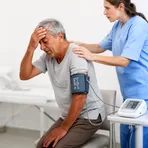
A drop in blood pressure when a person stands that causes dizziness or fainting
Surface Forms
Morphology
Both constituents directly contribute to the overall meaning: 'orthostatic' = pertaining to standing and 'hypotension' = low blood pressure, so the compound denotes low blood pressure associated with standing. Although it is medical jargon and may be low-frequency, the sense is fully compositional and predictable for a learner who knows the parts.
Etymology
Orthostatic hypotension comes from two parts: orthostatic, meaning 'standing up', and hypotension, meaning 'low blood pressure'. So, it is the name for when your blood pressure drops quickly as you stand and you may feel dizzy or faint.