
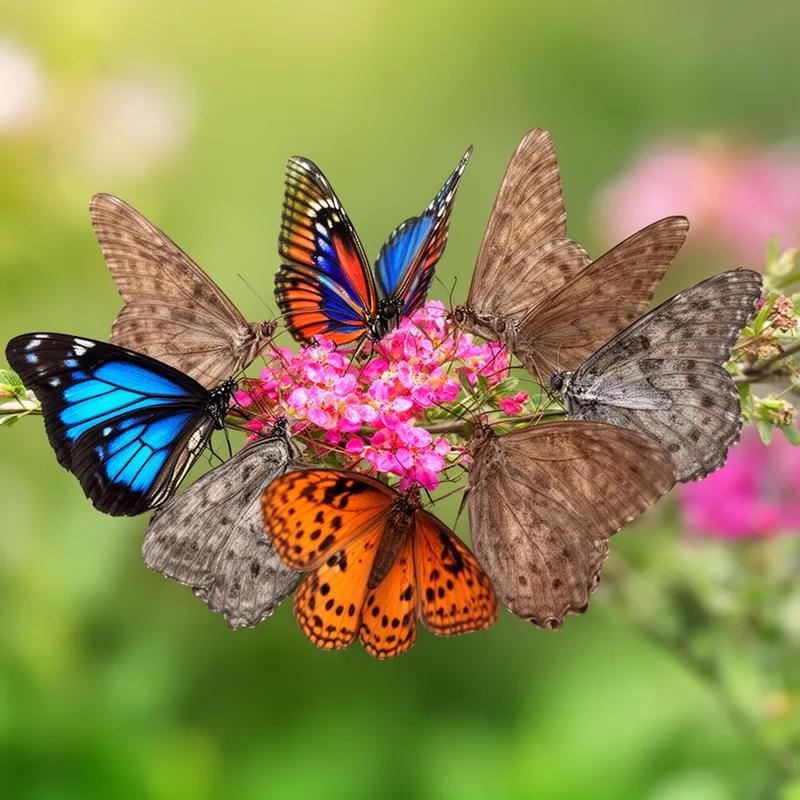
order Lepidoptera
- noun
- /ˈɔrdər ˌlɛpɪˈdɒptərə/
- Specialized
- The order Lepidoptera includes both butterflies and moths, which are known for their scaly wings.
Examples
-
Many species in the order Lepidoptera play important roles in pollinating plants.
-
Researchers study the order Lepidoptera to understand patterns of mimicry and evolution.
-
The order Lepidoptera includes thousands of species.
-
Many scientists study the order Lepidoptera for biodiversity.
-
Many species in the order Lepidoptera play important roles in pollinating plants.
-
Researchers study the order Lepidoptera to understand patterns of mimicry and evolution.
-
The order Lepidoptera includes both butterflies and moths, which are known for their scaly wings.
Synonyms
 1
9.9
1
9.9

A group of insects like butterflies and moths with tiny scales on their wings
Surface Forms
Morphology
Given 'order' as a taxonomic rank and 'Lepidoptera' as the name of the insect group, the phrase simply denotes the taxonomic group called Lepidoptera (moths and butterflies). This is a directly compositional, domain-specific but predictable combination following standard naming patterns, so a learner who knows both constituents will understand the meaning.
Etymology
The name order Lepidoptera comes from Greek words: lepido- means 'scale' and -ptera means 'wing'. Because butterflies and moths have tiny 'scales' on their 'wings', the phrase became the scientific 'group' name for these insects.