

order Testudines
- noun
- /ˈɔrdər ˈtɛstjuːdaɪnz/
- Specialized
- All living turtles and tortoises are classified within the order Testudines.
Examples
-
The order Testudines is distinguished by the presence of a bony or cartilaginous shell.
-
Paleontologists study fossils from the order Testudines to learn more about their early evolution.
-
The order Testudines is known for its unique shell structure.
-
Many species within the order Testudines are endangered.
-
All living turtles and tortoises are classified within the order Testudines.
-
Paleontologists study fossils from the order Testudines to learn more about their early evolution.
-
Many species within the order Testudines are endangered.
Synonyms

A group of animals that includes turtles and tortoises

A group of reptiles that includes all turtles and tortoises

A group of reptiles that includes tortoises and turtles

Animals like turtles and tortoises with a shell that covers their body
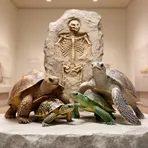
A group of reptiles that includes all turtles and tortoises
Surface Forms
Morphology
The phrase is compositionally transparent: 'order' denotes a taxonomic grouping and 'Testudines' names the shelled reptiles, so together they straightforwardly mean the taxonomic order of turtles/tortoises. This noun-noun taxonomic construction is a standard, predictable pattern (and common cross-linguistically), so a B1 learner who knows both constituents should be able to infer the MWE's meaning.
Etymology
The name order Testudines comes from the old Latin word testudo, which meant 'tortoise' or 'shell', and early scientists used that word for the group of animals with a hard shell. That's why order Testudines today means all turtles and tortoises.

