
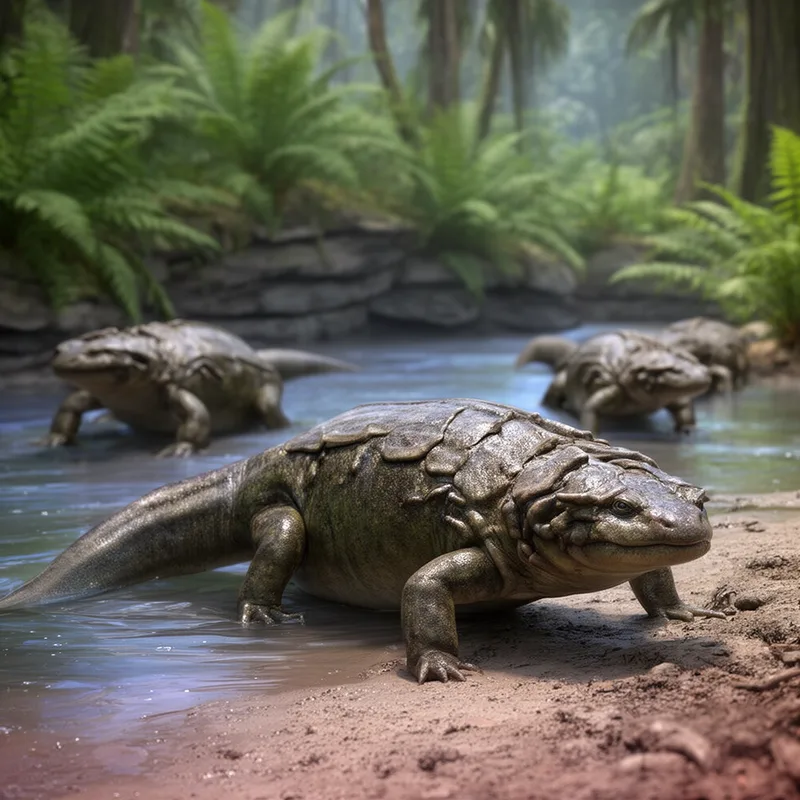
order Stegocephalia
- noun
- /ˈɔrdər ˌstɛɡoʊˈsɛfəliə/
- Archaic
- In the nineteenth century, paleontologists frequently classified prehistoric amphibians under order Stegocephalia.
Examples
-
The bony skulls characteristic of order Stegocephalia helped protect these ancient creatures from predators.
-
Many fossils from the order Stegocephalia have been discovered.
-
Fossils of order Stegocephalia provide insight into the early evolution of amphibians.
-
The order Stegocephalia includes various ancient amphibians.
-
Fossils of order Stegocephalia provide insight into the early evolution of amphibians.
-
In the nineteenth century, paleontologists frequently classified prehistoric amphibians under order Stegocephalia.
-
The bony skulls characteristic of order Stegocephalia helped protect these ancient creatures from predators.
Synonyms
Large extinct animals like frogs or salamanders with heavy armored skulls that lived long ago
Surface Forms
Morphology
The noun phrase is fully compositional: 'order' as a taxonomic rank combined with the proper name 'Stegocephalia' straightforwardly denotes the taxonomic grouping of those amphibians. A B1 learner who knows both words can reasonably infer it refers to the biological order containing Stegocephalia; this is a non‑idiomatic, cross‑linguistically common naming pattern.
Etymology
Order Stegocephalia comes from the Greek parts stego and cephalia, meaning 'roof' and 'head', because these ancient amphibians had heavy, roof-like skulls. Scientists used this name for an older 'group' of large, early salamander-like amphibians, so the name helps you remember they had big bony heads.

