

order Squamata
- noun
- /ˈɔrdər ˈskwɑːmətə/
- Specialized
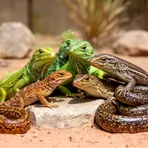
- They are members of the order Squamata, "the scaly ones," more popularly known as lizards and snakes.
Examples
-
Joints of the skull and jaws (arrows) help distinguish members of the order Squamata (lizards and snakes) from one another and from members of the closely related order Rhynchocephalia.
Academic text (2006) -
Reptiles in the order Squamata, such as chameleons and geckos, exhibit unique adaptations for survival.
-
The Komodo dragon is a fascinating member of the order Squamata, known for its impressive size and hunting skills.
-
Biologists study various species within the order Squamata to better understand their evolution and behavior.
Synonyms


 1
9.9
A large group of reptiles that includes snakes and lizards with scaly skin
Surface Forms
Morphology
This phrase is fully compositional: it combines the taxonomic rank 'order' with the taxon name 'Squamata', so if a learner knows 'order' in the biological sense and the meaning of 'Squamata' (a group of reptiles), the overall meaning is directly derivable. Rank + taxon constructions are cross-linguistically regular and therefore transparent to learners who know both constituents.
Etymology
Order Squamata gets its name from the Latin word squama, which means 'scale', and squamata simply means 'the scaly ones'. So in biology an 'order' is a group of related animals, and order Squamata refers to the 'scaly' group that includes snakes and lizards.