

order Isopoda
- noun
- /ˈɔrdər ˈaɪsəˌpoʊdə/
- Specialized
 :
orden Isópoda
:
orden Isópoda
- Scientists discovered a new species within the order Isopoda living in the deep sea.
Examples
-
The order Isopoda includes both terrestrial and aquatic species with diverse adaptations.
-
Common woodlice in gardens are familiar representatives of the order Isopoda.
-
The order Isopoda includes various species of woodlice.
-
Many scientists study the order Isopoda for ecological insights.
-
Many species of terrestrial isopods belong to the order Isopoda, including common woodlice that are often found in gardens.
-
The order Isopoda contains various crustaceans, known for their distinctive flattened bodies and multiple legs.
-
Researchers studied the order Isopoda to understand their unique adaptations to different environments.
Synonyms
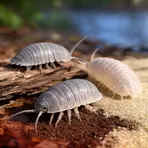
A group of animals like woodlice with a flat body and seven pairs of legs
Surface Forms
Morphology
This is a straightforward composition of 'order' (a taxonomic rank) and the taxon name 'Isopoda' so the meaning — the biological order Isopoda, a group of crustaceans including woodlice — is directly derivable from the parts. Taxonomic naming patterns like 'order X' are common across languages and in science, so a B1 learner who knows both constituents would readily understand it.
Etymology
Order Isopoda names a 'group' of crustaceans. The word Isopoda comes from Greek iso- 'equal' and -poda 'feet', and since these animals like woodlice have many similar legs and a flat body, the name makes a clear image of 'equal feet' to help you remember the group.

