
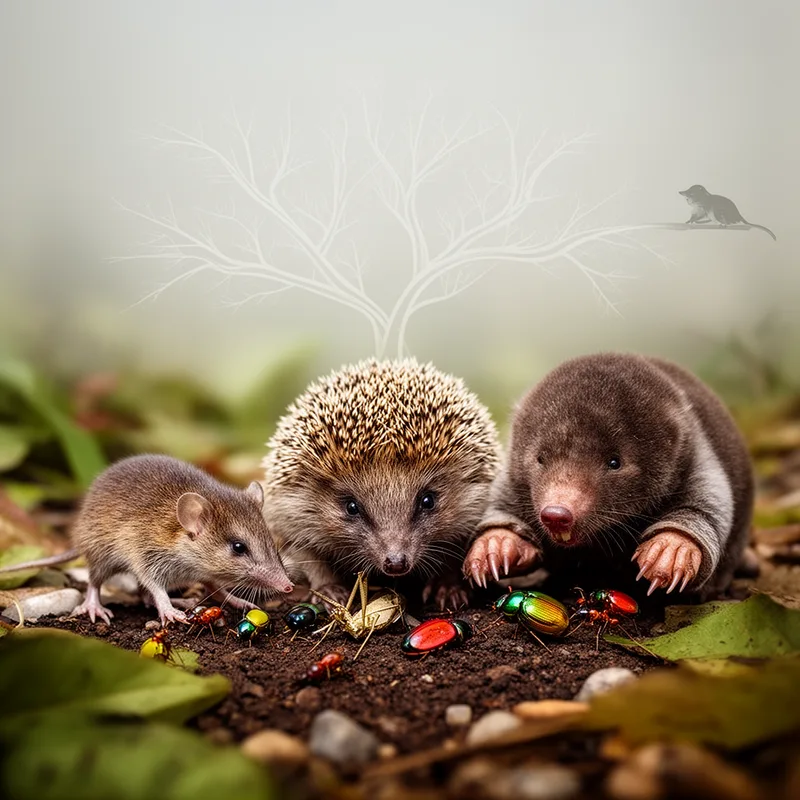
order Insectivora


 1
9.9
- noun
- /ˈɔrdər ɪnˈsɛktɪˌvɔrə/
- Archaic
- Some mammals now placed in other orders were previously classified under order Insectivora.
Examples
-
The order Insectivora includes many fascinating species.
-
The order Insectivora once included animals such as shrews and hedgehogs.
-
The classification of order Insectivora has mostly been replaced by more accurate groups based on genetic evidence.
-
Did you know the order Insectivora was once widely recognized?
-
The order Insectivora is characterized by small mammals that primarily feed on insects.
-
Many scientists study the order Insectivora to understand the evolution of insect-eating species.
-
Species like shrews and hedgehogs belong to the biological category known as Insectivora.
Synonyms
 1
9.9
A former group of small mammals that mainly eat insects, like shrews, moles, and hedgehogs
 1
9.9
A group of small, insect-eating mammals like moles, hedgehogs, and shrews no longer used in modern classification
Surface Forms
Morphology
This phrase is a straightforward compositional noun phrase: 'order' (a taxonomic rank) combined with the taxon name 'Insectivora' (insect‑eating mammals). Although the term is specialized, its meaning — the taxonomic order called Insectivora — is directly derivable from the known constituents and follows standard scientific naming patterns, so a learner who knows both words would understand it.
Etymology
Order Insectivora comes from Latin and literally means 'insect eater' because it combines insect and -vora, which means 'to eat'. It was used for a group of small mammals that eat insects, so the name explained what those animals do, though today scientists put many of them in other groups.