
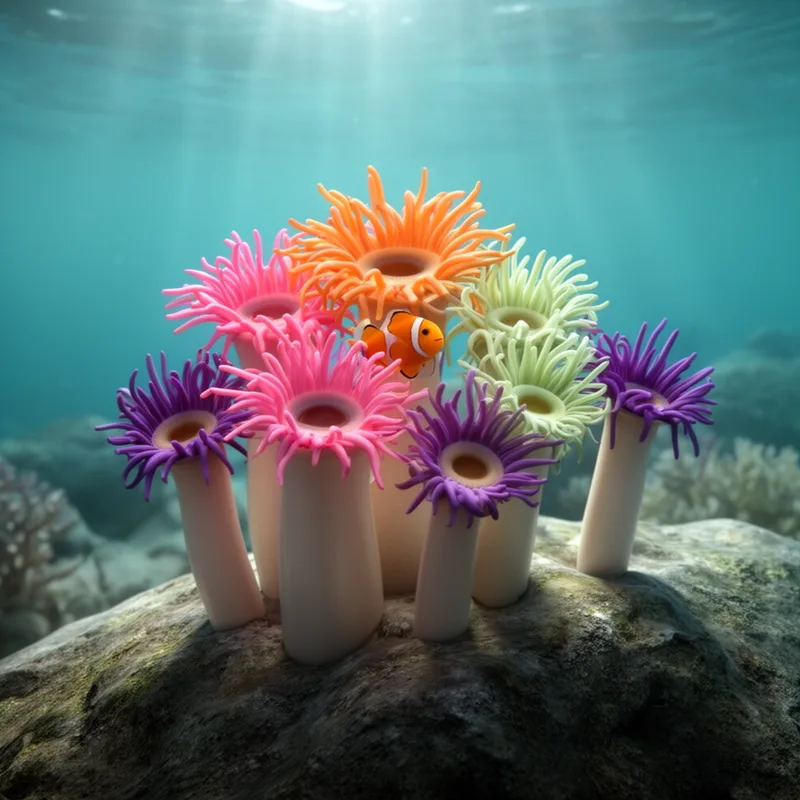
order Actiniaria


 1
9.9
- noun
- Specialized
- The order Actiniaria includes various species of sea anemones.
Examples
-
Several members of the order Actiniaria form symbiotic relationships with fish such as clownfish.
-
Researchers discovered a new species within the order Actiniaria near deep-sea hydrothermal vents.
-
The order Actiniaria includes a wide variety of sea anemones found in oceans around the world.
-
Many marine biologists study the order Actiniaria to understand their ecology.
-
The brightly colored sea anemones belong to the order Actiniaria, often found attached to rocks in tidal pools.
-
Divers often see various species of Actiniaria during their explorations of coral reefs.
-
In the scientific classification of marine life, the order Actiniaria consists mainly of organisms commonly referred to as sea anemones.
Synonyms
 1
9.9
A group of sea animals like sea anemones with a soft body and tentacles around the mouth
A group of related sea animals called sea anemones that live in the ocean
Sea animals with soft, colorful bodies and many tentacles that attach to rocks or coral
Surface Forms
Morphology
The phrase combines the general noun 'order' (a taxonomic rank) with the taxon name 'Actiniaria', so its meaning — the taxonomic order named Actiniaria, i.e. sea anemones — is directly derivable from the constituents. This follows a regular, cross-linguistic scientific naming pattern (e.g. 'order Primates'), making it transparent to learners who know both words.
Etymology
Order Actiniaria may come from a Greek word meaning 'ray' because these animals have many tentacles that spread out like rays around a central mouth. That's why the name is used for the scientific group of 'sea anemones'.