
orang
 3
4.6

- noun
- /ɔːræŋ/
- Although they are increasingly urban dwellers, most Orang Asli still live in remote rural settlements (Figure 2).
Examples
-
The Aboriginal Peoples Act narrowly circumscribes Orang Asli land and other rights.
Academic text (2011) -
Now, the orang-utan is attached to this brain-wave monitor.
-
Peninsular Malaysia Orang Asli Association, 1976, acts as a voice for Orang Asli concerns and culture.
Academic text (2011) -
Beginning in the late 1970s, many Orang Asli in the interior of the Peninsula were resettled in regroupment schemes within or close to their traditional areas.
Academic text (2011) -
The Orang Asli rejected the proposal (J. Lasimbang 2010, 346-347; Malaysia 2010, 162-164).
Academic text (2011) -
In the Peninsula, the main advocates of Orang Asli rights and interests are the Orang Asli Association of Peninsular Malaysia and the Center for Orang Asli Concerns.
Academic text (2011) -
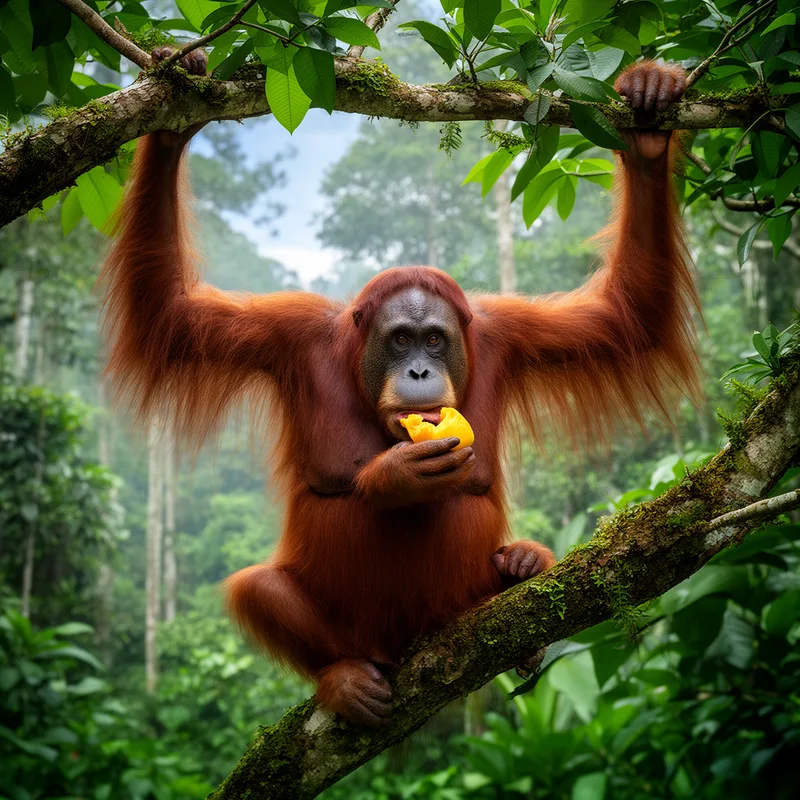
The orang swung effortlessly from branch to branch in the tropical rainforest.
-
As a symbol of conservation efforts, the orang represents the beauty of biodiversity.
-
The veterinarian studied the behavior of the orang to better understand its care needs.
Synonyms
 24
3.7
A large ape that lives in trees with long arms and red-brown hair from Borneo and Sumatra


 1
9.9
A large orangutan with long arms that lives in the rainforests of Borneo and Sumatra
Surface Forms
Etymology
Orang comes from the Malay word orang, which means 'person', and is the first part of orangutan, made from orang and hutan meaning 'forest', so orangutan means 'forest person'. That's why people used orang for the long-armed ape, because it was seen as a kind of 'person of the forest' that lives in the trees.