

oracle of Delphi
- noun
- /ˈɔrɪkəl əv ˈdɛlfaɪ/
- Literature
- Consumed by grief, Hercules sought out the Oracle of Delphi, who told him the path to atonement laid with his cousin, King Eurystheus of Tyrans.
Examples
-
- Behold, the oracle of Delphi speaks.
-
The lord who is the oracle of Delphi neither speaks nor is silent but gives a sign.
Fiction book (1992) -
Yet nothing lasts forever, and the Oracle of Delphi would be no exception.
-
Although the king of Crete heeds the oracle of Delphi as a divine pronouncement, he does not esteem the judgment of astrologers.
Academic text (1993) -
Many ancient Greeks traveled long distances to seek guidance from the oracle of Delphi, where the priestess delivered prophecies from Apollo.
-
Hercules visited the oracle of Delphi to receive a prophecy that would guide him on his quest for redemption.
-
The oracle of Delphi was known for its cryptic messages that influenced decisions made by leaders and common people alike.
Synonyms

 3
9.1
3
9.1

A place where people ask a god for advice or to learn the future

A woman at Delphi in ancient Greece who gives mysterious advice from the god Apollo to people who ask

A place in ancient Greece where a woman spoke for Apollo and gave unclear predictions
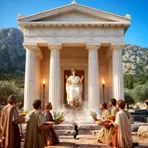
A Greek temple at Delphi where a priestess gives predictions from the god Apollo
Surface Forms
Morphology
The phrase literally combines 'oracle' (a shrine or person giving divine prophecies) with the place name 'Delphi', so a learner who knows both words will understand it refers to the prophetic shrine at Delphi. This is a straightforward noun + of + place composition found cross-linguistically, so the meaning is transparently derivable from its parts.
Etymology
Oracle of Delphi The oracle at Delphi was a priestess in a famous temple who spoke for the god Apollo and gave short, often puzzling 'prophecies' to people with big questions. That's why today the name is used for a person or source people see as a wise but sometimes mysterious 'advisor'.