
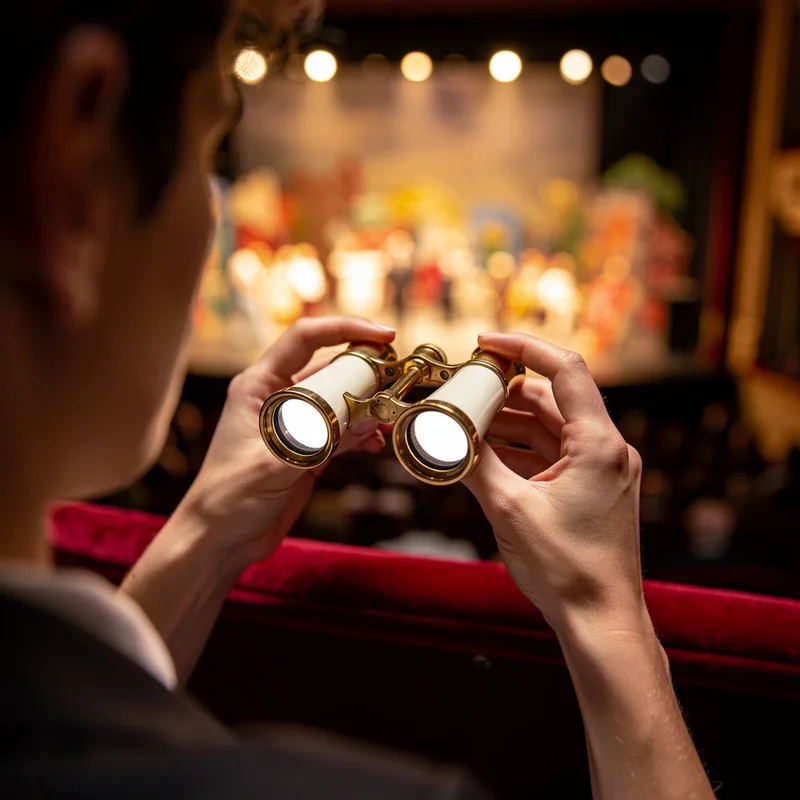
opera glasses
 2
4.2
2
4.2

- noun
- /ˈɑːpərə ˈɡlæsɪz/
- The usher reminded everyone that opera glasses are helpful for enjoying the subtleties of the live performance.
- looked through the opera glasses
Examples
-
From my seat in the theater, I used my opera glasses to get a better view of the performance on stage.
-
Audiences were advised to bring opera glasses to view the canvas, surveying the painting as if searching for a vista.
Academic text (2002) -
He hands her the opera glasses.
Fiction book (1997) -
Scarlett looked at them through the opera glasses she'd borrowed from Miss Eleanor.
Fiction book (1991) -
They were sitting in a box near the stage; on the barrier before them lay a pair of opera glasses made from mother-of-pearl.
Fiction book (2000) -
I hustled around the desk and reached in the drawer for Lisa's old opera glasses.
Fiction book (1992) -
Fester takes Morticia's opera glasses and peers appraisingly at the glittering finger trap.
Fiction book (1991) -
She pulled out her opera glasses to see the details of the actors' costumes during the show.
Synonyms


 1
3.3
1
3.3
A pair of binoculars used to see far things outdoors

Small binoculars used to see the stage at the theater

A pair of small tubes with lenses you hold to see far things with both eyes
How Magnified

Surface Forms
Morphology
The noun phrase is directly compositional: 'opera' (a staged performance) + 'glass' (an optical device) yields 'glasses used at the opera' — i.e. small binoculars to see the stage. This is a literal, functional combination that follows a common noun-noun naming pattern and would be inferable by a B1 learner who knows the constituents.
Etymology
Opera glasses comes from small handheld glasses people used at the opera to see the stage more clearly. They were like tiny binoculars you hold to your eyes, so the name now means 'small binoculars for the theater'.