
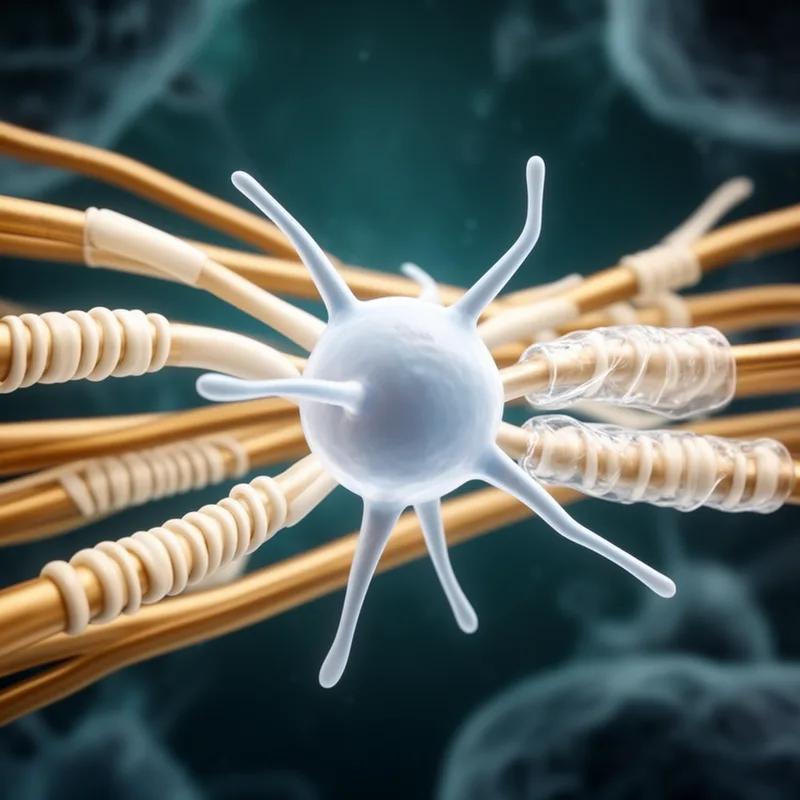
oligodendrocyte


 1
9.9
- noun
- /ˌɑlɪɡoʊˈdɛndrəˌsaɪt/
- Specialized
- oligodendrocytes wrap myelin
- astrocytes and oligodendrocytes
- oligodendrocytes will wrap
Examples
-
So now what about oligodendrocytes and Schwann cells?
-
OK, we'll talk about oligodendrocytes and how they also can inhibit the Axon growth.
-
Oligodendrocytes coat the axons with a myelin sheath to speed up neural signals.
-
The membrane of oligodendrocyte cells wraps around groups of axons, forming the myelin sheath.
-
As an adult learns a new skill, the brain produces new oligodendrocytes that enhance myelin around axons.
Surface Forms
Morphology
oligodendrocyte = oligo + dendro + cyte
The term is a specialized scientific compound from Greek combining forms ('oligo-' 'dendro-' '-cyte') that are not standalone English words for most learners, so the meaning ('a myelin-producing glial cell') cannot be derived by an average B1 learner from its parts.
Etymology
Oligodendrocyte comes from Greek parts oligo- 'few', dendro- 'tree', and -cyte 'cell', so it literally means a 'few-branch cell'. Picture a small tree with a few branches that reach out to many nerve fibers and wrap them with myelin, a fatty 'insulation', and that's why an oligodendrocyte is the cell that makes myelin in the brain and spinal cord.