

olfactory
 17
7.9
17
7.9

- adjective
- /ɑlˈfæktəri/
- Specialized
- Researchers now estimate that a mouse has 1,500 genes for olfactory receptors.
- olfactory receptor
- olfactory bulb
- olfactory sense
Loading YouTube…
Watch on YouTubeThese are variants in genes that encode for what are called olfactory receptors.
- These are variants in genes that encode for what are called olfactory receptors.
- But the place where this really happens is in the olfactory system.
- Yeah, maybe not surprisingly because mice tend to be very olfactory driven.
- OK, so all of this is olfactory sensory reality.
- You stop overwhelming your sensitory organs, your eyes, your ears, your feelings, your taste buds, your your nose, your olfactory.
- So the visual system, the auditory system, olfactory touch pane and so forth, all of these kind of come together or converge in the amygdala.
Examples
-
I'm over here take you back to the olfactory smell system.
-
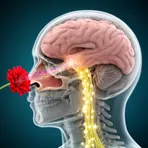
Dragging flowers to the nose shows how the olfactory bulb in the brain is stimulated.
Academic text (2015) -
OK, so all of this is olfactory sensory reality.
-
Only a visitor with no olfactory sense at all could approach him.
Fiction book (1996) -
I inherited my father's olfactory sense.
-
But, somehow, the olfactory nerves linking her smell to her brain became active again.
-
Rats have complex olfactory mechanisms to transmit information about food to others in the colony.
Academic text (1996) -
And estrogen has all sorts of receptors on olfactory neurons, so that makes sense.
-
A bulging vein, dangerously fragile, had pressed hard against a branch of the olfactory nerve.
Fiction book (1998) -
The olfactory nerve is essential for detecting various scents in the environment.
Synonyms

Relating to the sense of smell
Compounds

- Specialized

 1
7.1
1
7.1
A rounded part at the base of the brain just above the nose that helps you smell




- Specialized
Part of the brain that helps you smell and connect smells with feelings

- Specialized
A condition where you cannot smell things like smoke or perfume

Surface Forms
Morphology
olfactory = olfaction (semi-transparent) = olfact + ory
Derived from the noun 'olfaction' meaning 'sense of smell', but the root 'olfact-' is a Latin combining form unfamiliar to most learners.
Etymology
Olfactory comes from the Latin verb olfacere, which means 'to smell'. So olfactory describes anything to do with the nose or with 'smell', like an 'olfactory system' that helps you detect scents.