
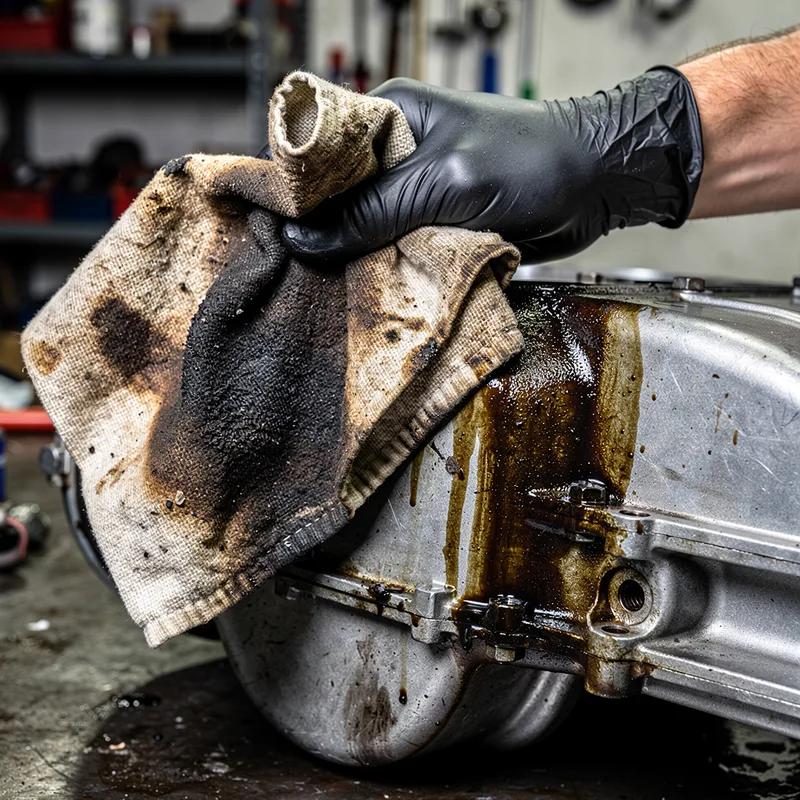
oily rag
 1
3.4
1
3.4

- noun
- /ˈɔɪli ræɡ/
 :
trapo aceitoso
:
trapo aceitoso
- oily rags and paint
Examples
-
- Were they wiped over with an oily rag?
-
You didn't wipe 'em with an oily rag before you put 'em away?
-
As we walked down the dock early in the morning, we saw him climb out of the engine well, wiping his hands on an oily rag.
Academic text (1997) -
Lando wiped his hands on an oily rag as he walked over to greet her.
Fiction book (1991) -
The tractor was giving him trouble, and he cursed as he cranked it up one more time, his hand wrapped in an oily rag, the sun beating down on the back of his neck.
Fiction book (1995) -
The mechanic used an oily rag to clean the engine parts.
-
After the repair, he tossed the dirty oily rag in the bin.
-
To keep the tools in good condition, store them with an oily rag for lubrication.
How Oily

Surface Forms
Morphology
The meaning ‘a piece of cloth soaked with oil’ is directly and transparently derived from combining 'oily' (having oil) with 'rag' (a small cloth). This simple adjectival + noun composition is a common, literal pattern across languages and would be clear to a B1 learner who knows both constituents.
Etymology
Oily rag comes from a simple picture: a rag soaked with oil for cleaning or polishing. Workers like mechanics or painters used them, and when left in a pile these oily rags can heat up and even 'catch fire', so the scene is easy to remember. That's why oily rag today means 'a piece of cloth soaked with oil used for cleaning or polishing'.