

occluded front


 1
7.5
1
7.5
- noun
- /əˈkluːdɪd frʌnt/
- Specialized
- Meteorologists announced that an occluded front is moving in, bringing cooler temperatures and rain.
Examples
-
There's an occluded front stalled over the Dakotas, backed up all the way to Utah.
-
The cyclone center is here, occluded front, back to here, warm front, cold front.
-
There's an occluded front stalled over the Dakotas.
-
A strong Pacific front is immediately offshore (the linear north-south feature) and connects with an occluded front that extends out into the Pacific into a well-defined Pacific low between northern Vancouver Island.
Blog text (31) -
The occluded front formed when the cold front overtook the warm front, causing the warm air to rise.
-
In winter, an occluded front can lead to significant snowfall as warm moisture is forced upward.
Synonyms
 70
5.1
70
5.1
The line where two types of air meet and change the weather
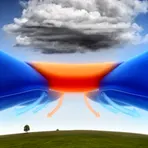
A weather front that forms when cold air surrounds and lifts warm air above ground
Surface Forms
Morphology
If a learner knows 'occluded' as 'closed/obstructed' and 'front' as a weather boundary, they can infer that an 'occluded front' is a front that has been 'cut off' or closed, so the basic idea is accessible from the parts. However, the specific meteorological process (a cold front overtaking a warm front and lifting the warm air) is technical and not predictable from the words alone, so the transparency is partial.
Etymology
Occluded front is a weather term that comes from the image of one front closing over another: a cold front catches up to a warm front and pushes the warm air up. Because the warm air is 'closed off' from the ground, it cools and makes clouds and steady rain, so the phrase refers to that kind of front.