

oblanceolate leaf
- noun
- /ˌoʊblænˈsiːəˌleɪt liːf/
- Specialized
- Botanists categorized the specimen by its distinctive oblanceolate leaf, broader near the tip than at the base.
Examples
-
Some wildflowers have an oblanceolate leaf that makes them easy to identify in the field.
-
The desert plant is notable for its oblanceolate leaf structure, which helps reduce water loss.
-
The oblanceolate leaf of the plant is quite unique.
-
Many species exhibit an oblanceolate leaf structure.
-
Botanists categorized the specimen by its distinctive oblanceolate leaf, which is broader near the tip than at the base.
-
Some wildflowers have an oblanceolate leaf that makes them easily recognizable in the field.
-
The desert plant features an oblanceolate leaf shape, allowing it to minimize water loss.
Synonyms
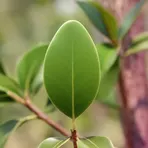
A leaf shaped like an egg with the narrow end near the stem
Surface Forms
Morphology
This is a straightforward adjective + noun composition: if a learner knows 'oblanceolate' as ‘broader at the tip and tapering toward the base’ and knows 'leaf', the combined meaning is directly derivable. The descriptive, compositional pattern (shape-term + object) is cross-linguistically common, so the phrase is transparent to learners who know the constituent words.
Etymology
Oblanceolate leaf comes from the parts ob- and lanceolate, where ob- means 'reverse' and lanceolate comes from the word 'lance', a spear. Imagine a spear turned the other way so the leaf is wider at the tip and narrower at the base, and that's why the term describes a leaf broader near the tip.

