
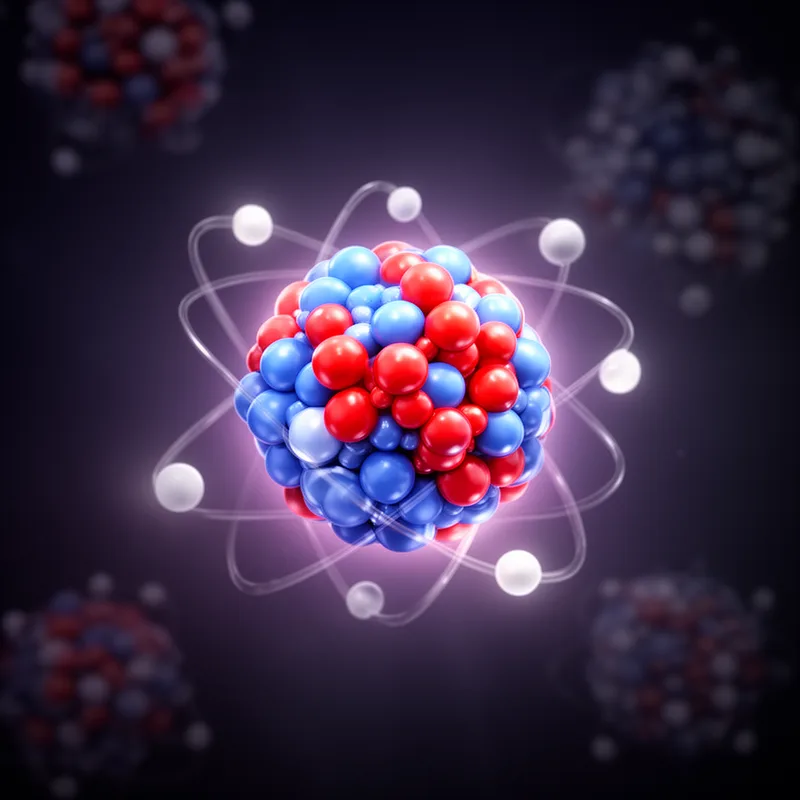
nuclide
 1
8.7
1
8.7

- noun
- /ˈnjuːklaɪd/
- Specialized
- The table of nuclides displays each nuclide's number of protons and neutrons.
- neutron-rich nuclides
- stable nuclides
- superheavy nuclides
Loading YouTube…
Watch on YouTubeThe easiest way to demonstrate that nuclear fusion took place would be to actually measure the helium nuclide that were supposedly produced.
- The easiest way to demonstrate that nuclear fusion took place would be to actually measure the helium nuclide that were supposedly produced.
Examples
-
In this way, Caamao and company identified 11 new isomeric states of neutron-rich nuclides with mass numbers from 188 to 203.
Academic text (2006) -
And then we go to the table of nuclides to get its atomic mass.
-
Figure 2 shows this wide-open region of unknown nuclides.
Academic text (2006) -
Access to heavy nuclides on the neutron-rich side of the valley of stability is experimentally difficult, but highly desirable.
Academic text (2006) -
While addressing a wide range of nuclear and applied science issues, these new facilities will provide important new opportunities for the study of isomers, especially in heavy, neutron-rich nuclides.
Academic text (2006) -
The chart of nuclides shows naturally occurring stable nuclides (black squares) clustered along the valley of nuclear stability.
Academic text (2006) -
A promising way of producing and studying neutron-rich nuclides and their excited states was pioneered at the GANIL laboratory in Caen, France, and the GSI laboratory in Darmstadt, Germany.
Academic text (2006) -
Researchers study nuclides to understand their stability and decay patterns.
-
Each nuclide is represented in the chart according to its unique combination of protons and neutrons.
Synonyms
 45
6.5
45
6.5
A form of a chemical element with the same number of protons but more or fewer neutrons in the nucleus
Surface Forms
Morphology
nuclide = nucleus (semi-transparent) = nucl + ide
Formally built from the stem related to 'nucleus' plus the technical suffix '-ide', but the precise technical meaning requires domain knowledge.
Etymology
The word nuclide comes from nucleus, which means 'core', and the chemical ending -ide, as in oxide, which names kinds of atoms. So a nuclide is a specific kind of atomic 'core' with a fixed number of protons and neutrons.