

nucleon number
- noun
- /ˈnjuːkliˌɒn ˈnʌmbər/
- Specialized
- The nucleon number of carbon-12 is 12, as it has 6 protons and 6 neutrons.
Examples
-
The difference between the nucleon number and the atomic number gives the number of neutrons.
-
A scientist can find the nucleon number by adding the number of protons and neutrons in the nucleus.
-
Knowing the nucleon number helps scientists determine the isotope of an element.
-
The nucleon number of carbon-12 is twelve.
-
What is the nucleon number of oxygen?
-
The nucleon number of an atom is crucial for understanding its stability and reactions.
-
In the periodic table, the nucleon number is often used to identify different isotopes of an element.
Synonyms


 1
4.9
1
4.9
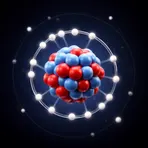
The total number of protons and neutrons in an atom's nucleus
Surface Forms
Morphology
The phrase literally denotes the 'number (count) of nucleons' and so its meaning — the total count of protons and neutrons in a nucleus — is directly compositional from 'nucleon' (protons and neutrons) + 'number' (how many). Although the term is scientific, the semantic combination follows a straightforward English noun-of-quantity pattern and is cross-linguistically regular, so a learner who knows both constituents will understand it.
Etymology
Nucleon number is like a headcount of the tiny particles in the centre of an atom: the word nucleon means the particles 'protons' and 'neutrons' and number means how many. So it tells the total of 'protons' and 'neutrons' and shows which version, or 'isotope', of the element you have.