
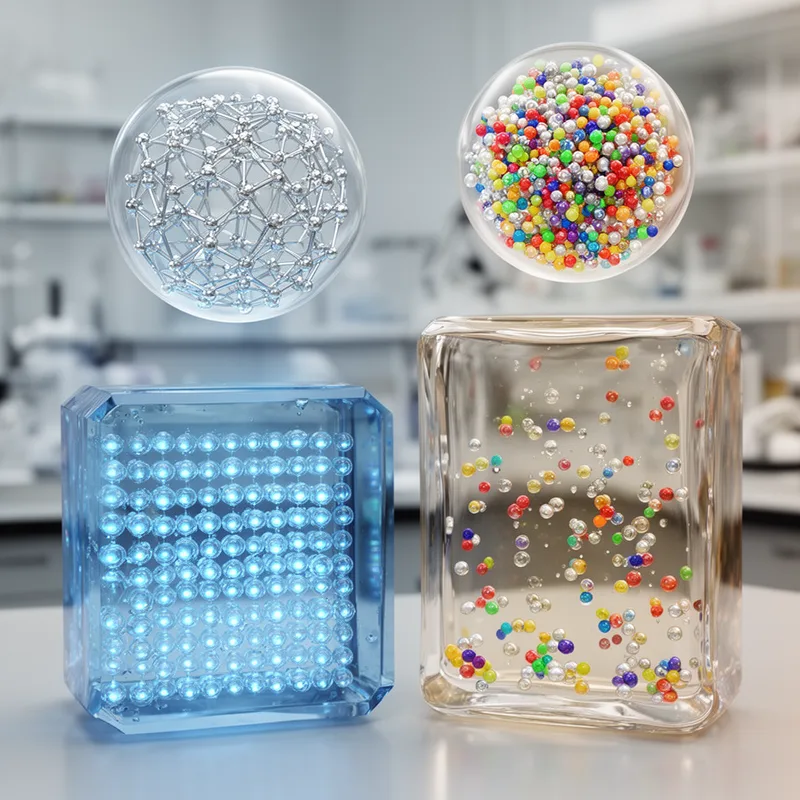
noncrystalline
- adjective
- /nɒnˈkrɪstəlɪn/
- Specialized
- Noncrystalline materials often exhibit unique properties that differ from their crystalline counterparts.
Examples
-
The team studied the properties of a new noncrystalline glass that could be used in electronics.
-
The physicist explained how noncrystalline substances can affect the conductivity of a material.
-
The gray curve is for bremsstrahlung in a noncrystalline target.
Academic text (2005) -
Disorder is commonly found in the noncrystalline organization of molecular semiconductors and in the conformation of polymer chains.
Academic text (2006) -
In the future, phasing complex structures, in both crystalline and noncrystalline forms, will continue to play an important role in biological and materials-science investigations at both fundamental and functioning levels.
Academic text (2006) -
Coherent diffraction imaging of noncrystalline specimens is analogous to x-ray crystallography, but with two important differences.
Academic text (2006) -
In the early 1980s, David Sayre proposed using coherent x-ray diffraction as an imaging technique to determine the electron density in a noncrystalline single-particle specimen.
Academic text (2006)
Synonyms

 5
7.3
5
7.3

Not having a clear shape or regular structure

Not in a solid crystal form

Not having a regular internal pattern like crystals
Antonyms

How Crystalline

Surface Forms
Morphology
noncrystalline = crystalline (transparent) = non + crystal + ine
The negative prefix 'non-' straightforwardly negates the adjective 'crystalline', and 'crystalline' is itself transparently related to 'crystal' + '-ine'.
Etymology
The word noncrystalline breaks into non- meaning 'not' and crystal, a word from a root that meant 'ice' or 'clear', and a crystal has a regular, repeating pattern. So, noncrystalline describes a material that does 'not' have that regular atomic order, like glass.