
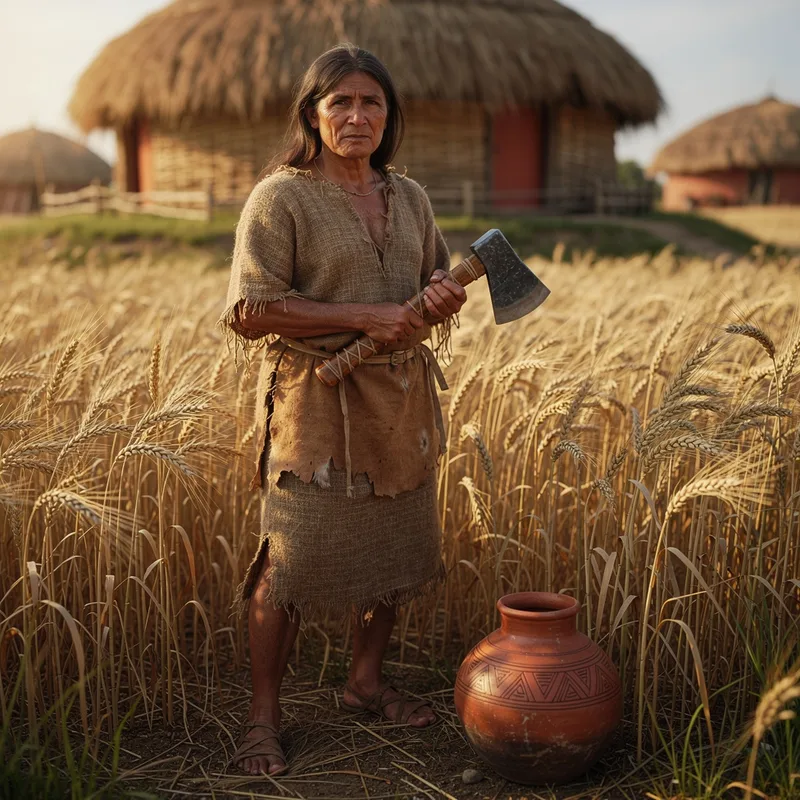
neolithic
 8
8.9
8
8.9

- adjective
- /niˈɑːlɪθɪk/
- Specialized
 :
neolítico
:
neolítico
- There is little evidence of Neolithic imagery in the mobiliary art of the Uralic peoples.
- Neolithic period
- Neolithic site
- Neolithic people
The name of this culture is called the PPNA Pre Pottery Neolithic A because there's APPNB pre Pottery Neolithic A.
- The name of this culture is called the PPNA Pre Pottery Neolithic A because there's APPNB pre Pottery Neolithic A.
Examples
-
Pottery found at the site shows the characteristic stroke decoration of Neolithic farming culture in Central Europe.
Academic text (2006) -
Archaeologists have uncovered a small Neolithic village dating to 4000 B.C. near today's airport.
Academic text (2011) -
There is no evidence of social hierarchy prior to this period, in the Neolithic, or Stone Age.
Academic text (2011) -
Any smaller remains, such as those from Neolithic times, are likely to go unnoticed.
Academic text (2011) -
Ideas about why Stonehenge was built need to account for Neolithic politics.
Academic text (2008) -
In fact, archaeologists have found such remains from as long ago as Neolithic times.
Academic text (1995) -
But he does agree that it was a sanctuary of profound significance in the Neolithic world.
Academic text (2008) -
A mile away is Silbury Hill, the largest Neolithic earthen formation in the world.
Academic text (2003) -
As agriculture transformed their way of life, newly sedentary Neolithic people ceased to make the pilgrimage.
Academic text (2008) -
Archaeologists have uncovered a small neolithic village dating to 4000 B.C. near today's airport.
Compounds

Surface Forms
Morphology
neolithic = neo + lith + ic
Built from Greek combining forms neo- ('new') + -lith- ('stone') + -ic; the meaning 'New Stone Age' is reconstructible for learners familiar with 'neo-' or 'stone', but the combining form 'lith-' is not a standalone English word, reducing full transparency.
Etymology
The word neolithic comes from Greek parts neo- 'new' and -lithic 'stone', so it literally means 'new stone' and refers to the later Stone Age when people used polished stone tools and began farming.