

naval forces
 5
3.4
5
3.4

- noun
- /ˈneɪvəl ˈfɔrsɪz/
- Specialized
- A conflict with only naval forces would be quickly settled in favor of the U.S. Navy.
- air and naval forces
- U.S. naval forces
- American naval forces
Loading YouTube…
Watch on YouTubeSecond, everything depends on the balance of naval forces between China and the United States.
- Second, everything depends on the balance of naval forces between China and the United States.
Examples
-
World War II history buffs know that the decisive American defeat of the Japanese naval forces in these waters in June 1942 was the turning point in the Pacific theater.
Academic text (1999) -
Second, everything depends on the balance of naval forces between China and the United States.
-
In the normal course of events... the Japanese would communicate this information... to their air and naval forces up here.
-
A major sea incident takes place near Georgia with Russian naval forces.
Blog text (12) -
Air and naval forces of the United States... launched a series of strikes against terrorist facilities...
-
I am ordering U.S. air and naval forces to help defend South Korea.
Fiction book (2000) -
As naval forces took a more active role in the pirate wars, there were inevitably some fierce battles.
Academic text (2009) -
Under the command of General Eisenhower, Allied naval forces, supported by strong air forces, began landing Allied armies this morning on the northern coast of France.
-
Before the Punic Wars, which made them famous, the Carthaginians stood as one of the most pre eminent naval forces of their era.
-
The U.S. naval forces are conducting training exercises to improve their readiness for potential conflicts.
Synonyms
 203
2.0
203
2.0
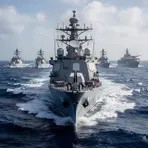
The part of a country's military that fights at sea
How Big

Surface Forms
Morphology
The meaning is directly and transparently derived from 'naval' (related to the navy/sea) combined with 'forces' (a military group), so a B1 learner who knows the parts can infer it refers to a country's sea military units. This adjective+noun composition is a common, compositional pattern and is cross-linguistically regular, making it immediately comprehensible.
Etymology
Naval forces comes from the parts naval, meaning 'ships', and forces, meaning 'armed groups'. Imagine a group of warships sailing and working together like an army at sea — that's why naval forces means 'military ships and supporting units' today.