
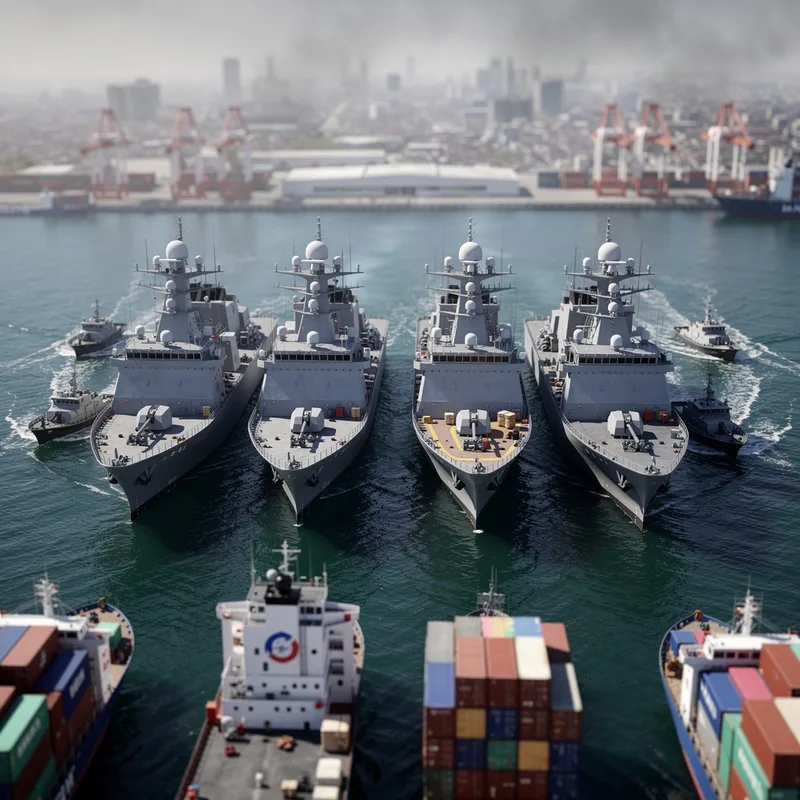
naval blockade
 4
7.3
4
7.3

- noun
- /ˈneɪvəl bləˈkeɪd/
- During the Cuban missile crisis, the U.S. implemented a naval blockade to prevent Soviet ships from delivering missiles to Cuba.
- naval blockade of Gaza
- naval blockade of Hamas
- Israel's naval blockade
Loading YouTube…
Watch on YouTubeThese included a declaration of war, a naval blockade, and the mining of Iranian ports.
- These included a declaration of war, a naval blockade, and the mining of Iranian ports.
Examples
-
In response to the secession of the Southern states, President Abraham Lincoln quickly imposed a naval blockade of the U.S. coast from Virginia to Texas.
Academic text (2011) -
To weaken the enemy's position, the coalition forces decided to enforce a naval blockade on their shipping routes.
-
The United States has employed and will likely in the future continue to use naval blockades when necessary.
Academic text (2007) -
The United States is threatening a naval blockade.
-
Both nations had used naval blockades to stop U.S. goods from reaching each other's ports.
Fiction book (1999) -
At sea, the British maintain their naval blockade of Germany, preventing the import of food and other vital raw materials.
-
During the Cuban missile crisis, for example, a naval blockade was employed instead of direct military attacks.
Academic text (2007) -
The mandate authorized nations to enforce a naval blockade of Serbia and Montenegro to ensure that the sanctions on strategic goods earlier imposed by the United Nations were fully effective.
Academic text (1993) -
The British established a naval blockade around Germany to restrict the delivery of supplies during World War I.
Synonyms
 72
5.8
72
5.8
An action that stops people and goods entering or leaving a place, often during war

 1
6.7
1
6.7
Soldiers or ships surround a place to stop supplies and force it to give up
How Effective
4
7.3
 9
6.0
9
6.0
Surface Forms
Morphology
The meaning is directly derivable from combining 'naval' (related to a navy) with 'blockade' (preventing entry or exit): it clearly denotes a blockade carried out at sea by naval forces. This compositional pattern is transparent and cross-linguistically common, so a B1 learner who knows both words will readily infer the MWE's meaning.
Etymology
Naval blockade comes from a clear picture: military ships (the naval part) form a line or stay near a port to stop other ships (the blockade part) from coming in or going out. So, a naval blockade means using ships to 'cut off supplies' and stop shipping in a war.