

native cranberry
- noun
- Australian
- Many gardeners appreciate the native cranberry for its bright scarlet flowers and low-growing form.
Examples
-
The native cranberry is prized for its tart, edible berries in some Australian regions.
-
Unlike true cranberries, the native cranberry thrives in drier, sandy soils.
-
Gardeners often plant native cranberry as an ornamental shrub for its vibrant flowers.
-
The native cranberry thrives in acidic soils.
-
Many gardeners love the native cranberries for their beauty.
-
The native cranberry produces small, tart berries that can be used in jams and desserts.
-
In Australia, the native cranberry is often found in dry, sandy areas, providing a colorful addition to the landscape.
Synonyms
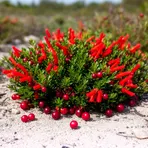
A small low shrub from Australia with red flowers and small edible fruit like cranberries

A small Australian low-growing shrub with scarlet flowers and small cranberry-like fruit

A low bush with bright red flowers and small edible fruits like cranberries
Surface Forms
Morphology
The phrase simply combines the modifier 'native' (indigenous/local) with the noun 'cranberry' to denote a cranberry species or variety that is local, so the overall meaning is directly derivable from the parts. There is no idiomatic or metaphorical shift and the modifier+noun composition is a common, cross-linguistic pattern, making it immediately understandable to a B1 learner who knows both words.
Etymology
The name native cranberry may come from how the plant looks: a local shrub that makes small, red, tart fruit like a cranberry. Calling it native shows it grows in the area, so the name helps you remember it is a local plant with cranberry-like berries.

