
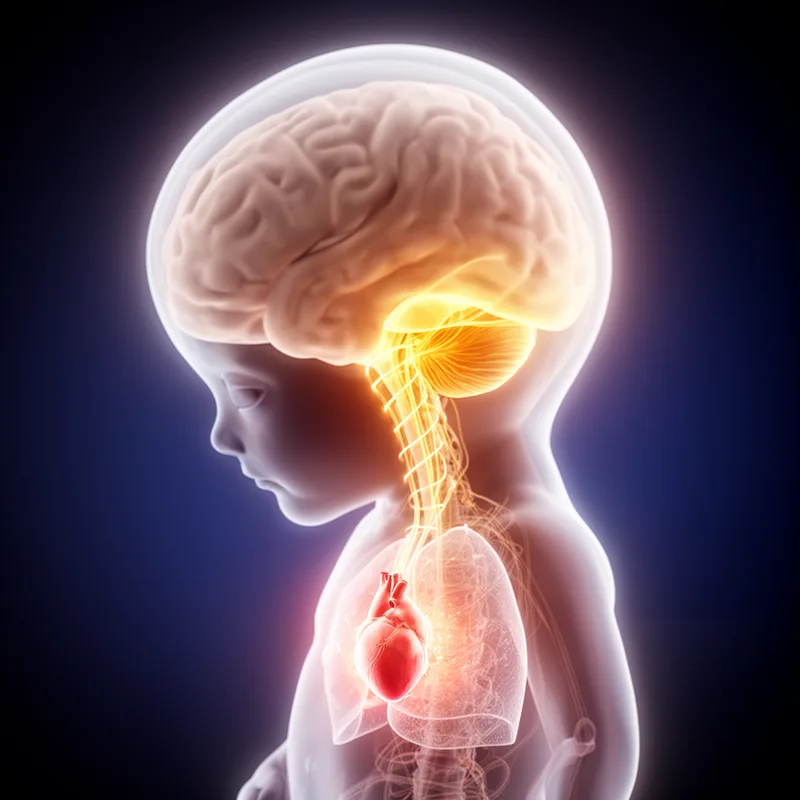
myelencephalon


 1
9.9
- noun
- /ˌmaɪəˈlɛnˌsɛfəlɒn/
- Specialized
- Researchers observed the early differentiation of the myelencephalon in amphibian embryos.
Examples
-
Damage to the myelencephalon can affect vital autonomic functions in vertebrates.
-
The myelencephalon is crucial for autonomic functions.
-
During fetal development, the myelencephalon gives rise to the medulla oblongata.
-
In vertebrates, the myelencephalon develops into the medulla oblongata.
-
The myelencephalon develops into the medulla oblongata, a critical area for regulating heart rate and breathing.
-
The embryonic structure known as the myelencephalon eventually evolves into the brain stem in adult vertebrates.
-
Researchers study the myelencephalon to understand its role in the development of vital brain functions.
Surface Forms
Morphology
myelencephalon = encephalon (opaque) = myel + encephalon
Both elements are Greek medical combining forms (the prefix 'myel-' is not a standalone English word), so the structure and meaning are not transparent to average learners.
Etymology
Myelencephalon comes from myel- meaning 'marrow' or 'spinal cord' and -encephalon meaning 'brain'. It names the back part of the developing brain that later becomes the medulla, the area that controls basic life functions like breathing and heartbeat. So the word points to the 'spinal' or marrow-like part of the brain and explains its vital role.