
mycetoma


 1
9.9
- noun
- /maɪˈsiːtoʊmə/
- Specialized
- Patients diagnosed with a mycetoma may require long-term treatment to prevent complications.
- patients with a mycetoma
Examples
-
Based on the patient's medical history and the combination of mass density on CT and hypointensity on MRI, a diagnosis of mycetoma was established.
Academic text (2008) -
One type of mycetoma is caused by actinomycetes (actinomycetomas), and another by true fungi (sinonasal masses).
Academic text (2008) -
Treatment of mycetoma usually involves surgical removal of the fungus ball, often without any need for further therapy.
Academic text (2008) -
In the rhinologic literature, they are often referred to as mycetomas.
Academic text (2004) -
Clinically, mycetomas can present as solid masses.
Academic text (2008) -
Some patients with a mycetoma may complain of chronic sinusitis, while others are asymptomatic.
Academic text (2008) -
Although mycetomas are most common in tropical climates, they are also seen in temperate regions.
Academic text (2008) -
A mycetoma is a colonization of benign fungal hyphae in the sinonasal cavity.
Academic text (2008) -
Whereas invasive fungal sinusitis is more common in immunocompromised patients, mycetomas are more often seen in immunocompetent patients.
Academic text (2008) -
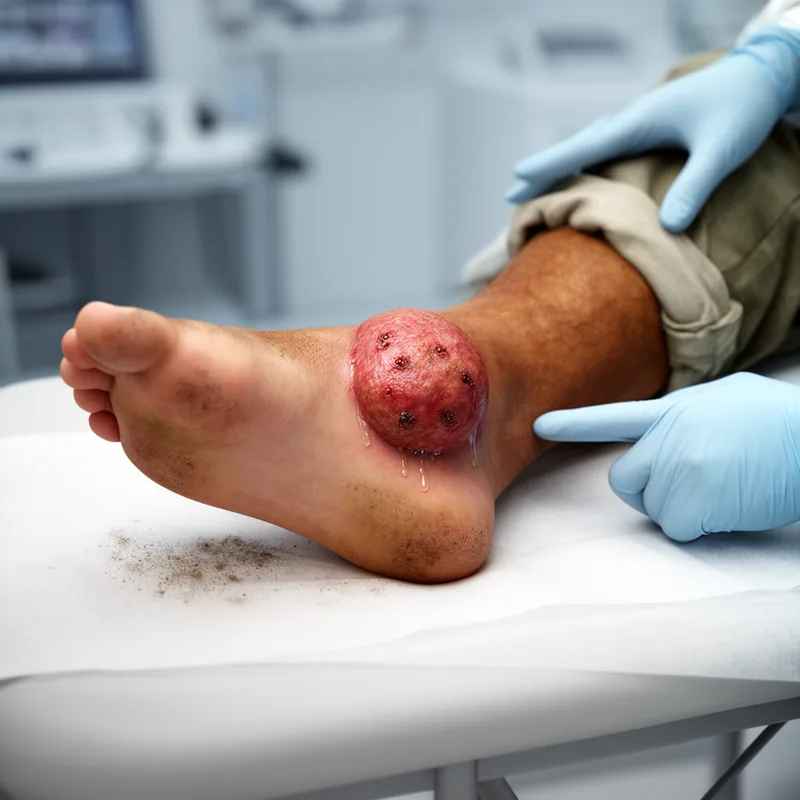
A mycetoma is a chronic infection that can cause painful swelling and discharge if left untreated.
How Severe
- Specialized

- Specialized
1
9.9
Surface Forms
Morphology
mycetoma = mycet + oma
Formed from Greek combining forms 'mycet-' (fungus) + '-oma' (tumor) used in medical terminology; these elements are not recognizable to an average B1 learner, so the meaning is not derivable from common English vocabulary.
Etymology
Mycetoma comes from Greek parts mycet- meaning 'fungus' and -oma meaning 'tumor' or 'swelling'. So it literally means a 'fungus swelling', which helps explain why the word describes a long, tumor-like infection of the skin or tissue.