

musk turtle
- noun
- /mʌsk ˈtɜːr.təl/
- US
- He found that only the musk turtle model gained slightly more heat when the light source was at a 25-degree angle of incidence from the animal's head.
Examples
-
PHOTO (BLACK & WHITE): Figure 2. A common musk turtle basking on a rock.
Academic text (1992) -
My students and I acquired several painted and musk turtles, set up an indoor rectangular aquarium equipped with heat lamps on one side (figure 1), and provided them with earthworms and pieces of raw hamburger.
Academic text (1992) -
Because snapping turtles and musk turtles burrow and hibernate, algal infestation is slower on these genera.
Academic text (1992) -
The musk turtle releases a strong odor to deter predators when it feels threatened.
-
In our local pond, we often spot the musk turtle swimming along the lily pads.
-
My friend has a musk turtle that he rescued from a nearby stream, and it has a very distinct smell.
Synonyms


 1
9.9
1
9.9
A small North American turtle that gives off a strong smell when scared
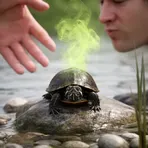
A small North American freshwater turtle that gives off a strong smell when frightened
Surface Forms
Morphology
The phrase is a simple noun–noun compound where 'musk' describes a characteristic of the turtle; knowing 'musk' (a strong odor) and 'turtle' (the reptile) allows a learner to infer it is a turtle that produces a musky smell. This compositional modifier+head pattern is common and cross-linguistically transparent, so a B1 learner who knows the constituents would understand the meaning.
Etymology
Musk turtle comes from the turtle's strong musk, a bad-smelling fluid it gives off when scared to keep predators away. That's why the name refers to a turtle known for its smell and why people sometimes call it 'stinkpot'.