
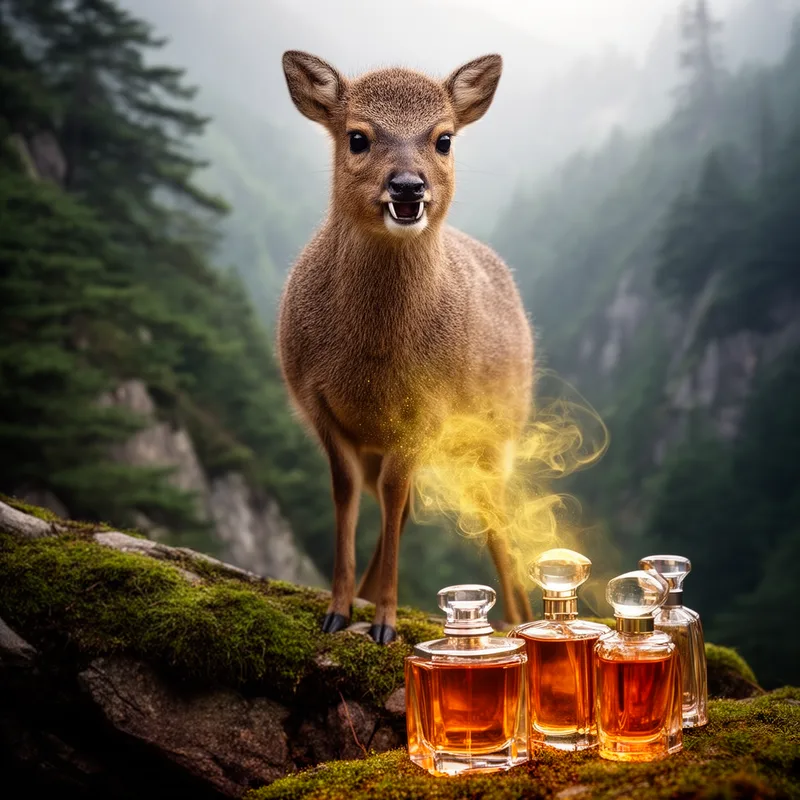
musk deer
- noun
- /mʌsk dɪr/
- Indian
- Our finds included barking deer, a musk deer the size of a big dog, sambar, a large deer with three-pointed antlers, wild boar, and giant panda.
Examples
-
The Sika deer is abundant, but even more common, judging from the heaps of gleaming droppings, is probably the small musk deer.
Fiction book (1996) -
The musk deer is known for its ability to thrive in harsh upland environments.
-
Of late, about 70 percent of the musk deer have been destroyed.
Academic text (1993) -
As before, they can collect ginseng roots and catch musk deer that they can sell to the Chinese across the border.
Fiction book (1996) -
The items most sought after by traders are certain medicinal herbs that grow at the highest altitudes, the musk glands of male musk deer, and the gallbladders of Himalayan black bears.
Academic text (2000) -
Many people appreciate the fragrance of perfumes made from the musk secreted by male deer.
-
Conservation efforts are vital to protect the endangered musk deer in central Asia.
Synonyms
A small heavy deer from central Asia whose male makes a strong-smelling substance used in perfume

A small deer from Asia without antlers whose males produce musk used in perfume

A group of small deer from Asia whose males have a scent gland
How Musky


Surface Forms
Morphology
The meaning 'a deer associated with musk' is directly compositional from 'musk' (an aromatic extract) + 'deer' (a hoofed mammal): it denotes a deer that produces or is characterized by musk. This noun–noun compound follows a common descriptive compounding pattern found across languages, so a B1 learner who knows both constituents would very likely infer the intended meaning.
Etymology
Musk deer gets its name from the strong smell made by the male deer. The males have a small body part that makes musk, a strong scent once used in 'perfume', so people called the animal musk deer.