
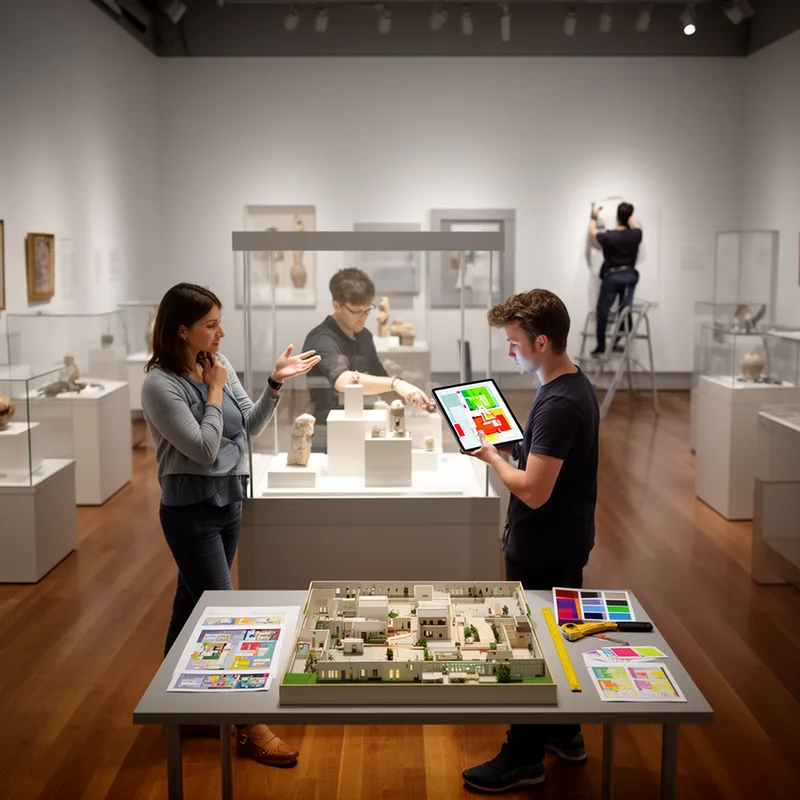
museography


 1
9.9
- noun
- /mjuːˈzɪəɡrəfi/
- Specialized
- Studying museography involves understanding how to effectively showcase historical artifacts.
Examples
-
The Museum of Ethnography in Geneva ("le MEG") is one of those currently in the process of redeveloping its exhibition spaces, rethinking its museography and its role in society.
Academic text (2008) -
The museum hired an expert to improve its museography and create more engaging displays.
-
A specific museography cannot be described now as it will take shape as work on the collection progresses.
Academic text (2008) -
It is intended to have exhibitions of African ethnography as well as African art, classical and contemporary, but always with a highly critical angle to the museography, with an emphasis on the understanding of ideas and social relations and the development of comparative approaches to social phenomena.
Academic text (2008) -
Her passion for museography led her to design several innovative exhibitions for local museums.
Synonyms
 1
8.7
The study of museums and how to run them
Surface Forms
Morphology
museography = museum (semi-transparent) = museo + graphy
The word is built on the recognizable base 'museum' with the learned suffix '-graphy', but the specialized sense referring to museum design and display is not fully predictable from the parts alone.
Etymology
Museography comes from museum ('a place for objects and art') and the ending -graphy (as in photography and geography) meaning 'writing about' or 'the study of'. So, museography is the work of planning, designing, and arranging how things are shown in a museum.