
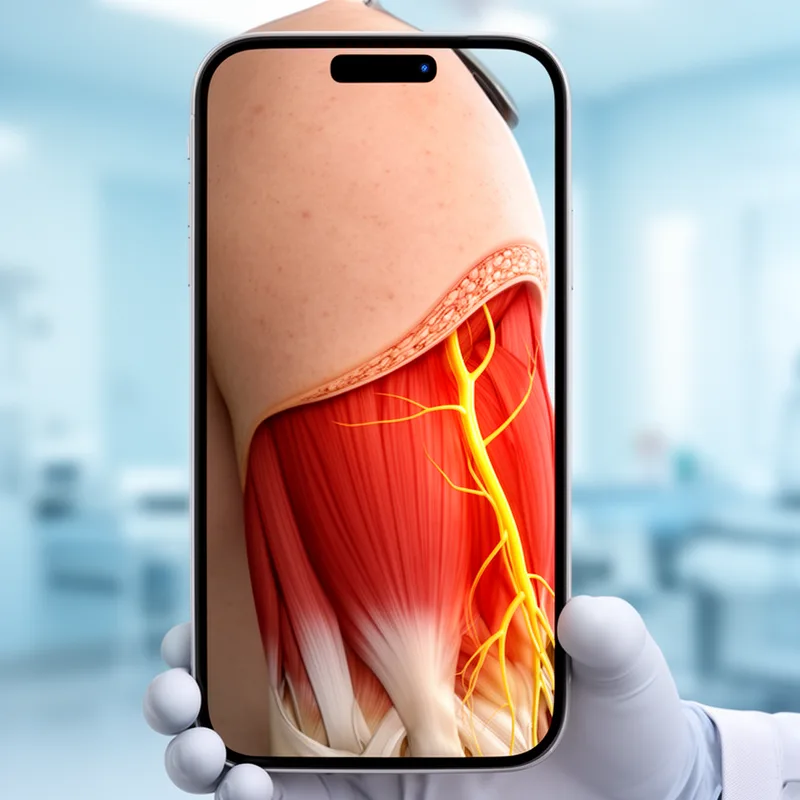
musculocutaneous


 1
8.3
- adjective
- /ˌmʌskjuloʊkjuˈteɪniəs/
- Specialized
- Yes, you can actually see the musculocutaneous nerve through the skin.
- musculocutaneous flap
Examples
-
The skin defect was reconstructed with a musculocutaneous flap taken from the pectoralis major and with a gauntlet (pedicle) flap taken from the temporalis.
Academic text (2003) -
The chest wall skin is then elevated with the pectoralis major muscle as a composite musculocutaneous flap to maximize vascularity, especially in radiated patients.
Academic text (2012) -
Insert where the musculocutaneous nerve meets the spinal cord.
-
The LD musculocutaneous flap is elevated in the standard fashion and without denervation of the muscle.
Academic text (2012) -
Figure 3 shows a typical result following inverted LD musculocutaneous flap breast reconstruction.
Academic text (2012) -
Perforator flaps offer several distinct advantages over muscle and musculocutaneous flaps that were noted in this series.
Academic text (2005) -
With experience and coordination, flap dissection can be accomplished in times comparable to those for muscle and musculocutaneous flaps.
Academic text (2005) -
To provide more robust skin flaps, the breast skin is elevated with the underlying pectoralis major muscle as a composite musculocutaneous flap.
Academic text (2012) -
The latissimus dorsi (LD) musculocutaneous flap is commonly used for delayed breast reconstruction (1-19).
Academic text (2012) -
The surgeon expertly dissected the musculocutaneous nerve to avoid damaging surrounding tissues.
Surface Forms
Morphology
Etymology
Musculocutaneous joins musculo- ('muscle') and cutaneous ('skin'), so it means 'about muscle and skin'. Doctors use it in anatomy to describe a nerve or tissue that affects both movement and feeling.