
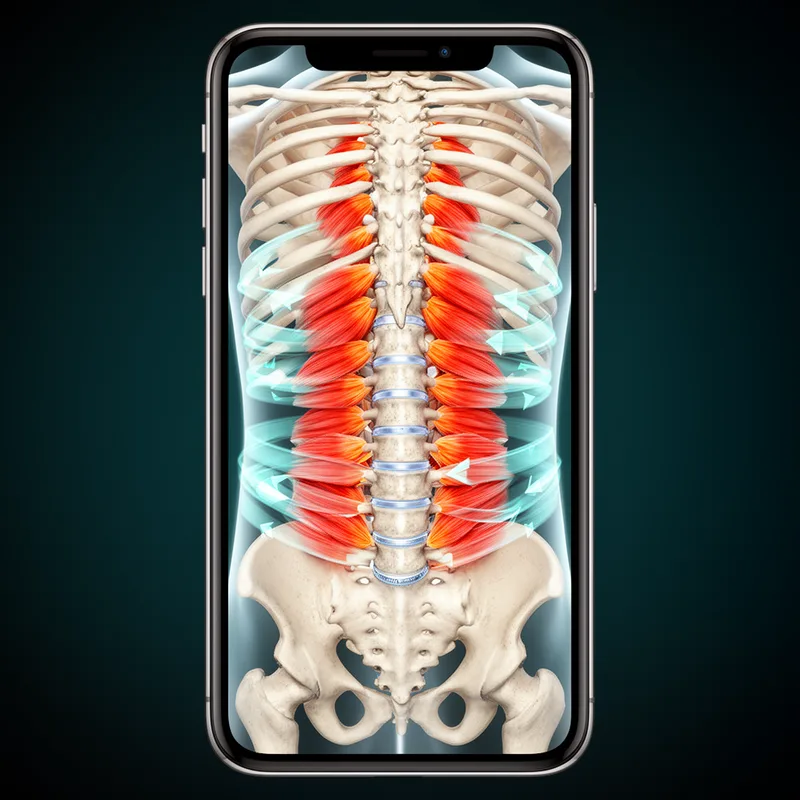
multifidus


 1
9.9
- noun
- /ˌmʌl.tɪˈfɪ.dəs/
- Specialized
- The data are plotted separately for the m. longissimus (upper), m. iliocostalis (middle), and m. multifidus (lower) as well as for left- and right-sided muscle groups.
- multifidus muscle
Examples
-
Strengthening the multifidus can help prevent lower back pain in individuals with weak core muscles.
-
Comparison of the decline in MF between the Longissimus and Multifidus muscles at the L3 vertebral level.
Academic text (1997) -
In a small group of subjects without back pain, the MF decline of the longissimus and multifidus muscles at L3 was obtained from recordings of intramuscular wire electrodes (32).
Academic text (1997) -
The electrodes are placed bilaterally to detect EMG signals from the longissimus thoracis, iliocostalis lumborum, and multifidus muscles (Figure 1).
Academic text (1997) -
The multifidus muscles play a crucial role in stabilizing the spine during movement.
-
Physical therapists often focus on activating the multifidus to enhance spinal stability in their patients.
Surface Forms
Morphology
multifidus = multi + fidus
Although the form reflects the same Latin elements, the noun is a specialized anatomical term whose referent is not directly inferable for most learners.
Etymology
Multifidus comes from the Latin parts multi- 'many' and -fidus 'split', and it names a deep back muscle made of many small parts along the spine. So the word helps you remember that this muscle is formed of many pieces that work together to keep the spine steady.