

mud brick


 1
2.7
1
2.7
- noun
- /mʌd brɪk/
- Walls were built of mud bricks and were windowless.
- made of mud brick
Loading YouTube…
Watch on YouTubeAnd soon, you know, they're building huge structures out of mud brick.
- And soon, you know, they're building huge structures out of mud brick.
- And they were moving into these really remote environments, you know, several hours drive from the main cities where people had built their, their houses out of mud brick.
- Same with sculpture, you know, stone, steel, mud bricks, whatever it may be.
Examples
-
Spreading out from Garama's monumental center were suburbs made up of numerous houses, mostly rectangular and made of mud brick.
Academic text (2004) -
The ancient structures were primarily built using mud brick, which helped keep them cool in the hot climate.
-
Unlike others in the Roman world, they are made of mud brick, not stone.
Academic text (2008) -
Same with sculpture, you know, stone, steel, mud bricks, whatever it may be.
-
There can also be patterns made in mud bricks, and this one, of course, is something related to the palm tree.
-
Made of mud brick, they were erected from the first to the fourth centuries A.D.
Academic text (2004) -
Well, when the city met its end, these mud brick walls collapsed and they actually fell down to the base of the stone retaining wall.
-
At its base was a stone retaining wall more than 15 feet high, with a defensive extension wall of mud bricks rising higher still.
-
The streets behind its tall mud brick walls bounded blocks of low houses, many equipped with Greek style bathing rooms.
-
It is identical to every other house in the village: a one-story walled hut made out of mud bricks.
Fiction book (1996)
Synonyms
 440
1.0
440
1.0
A hard rectangular block of baked clay used to build walls or paths
 11
5.1
11
5.1
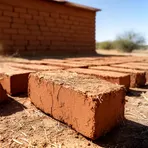
A brick made from earth, clay, sand, and straw dried in the sun to build houses in hot dry places
 1
5.0
1
5.0
A brick made from clay and straw that dries in the sun for building in hot dry places
How Durable

Surface Forms
Morphology
The meaning is directly composed from 'mud' (soft earth) + 'brick' (a building block), so a B1 learner who knows both words can infer a brick made from mud. This type of compound is cross-linguistically common (e.g. 'adobe' equivalents) and follows straightforward noun+noun composition, making it transparently interpretable.
Etymology
Mud brick comes from a simple building image: people mixed wet mud with straw, pressed it into a brick, and left it to dry in the sun. Because these sun-dried blocks were used to build walls and houses, the name now means 'a brick made by shaping mud and letting it harden'.