

motoneuron


 1
8.4
1
8.4
- noun
- /ˈmoʊtəˌnjʊrən/
- Specialized
- Furthermore, afferent information from joint receptors may project to gamma motoneurons, thus causing alterations in muscle tone at and around the injured site (51, 52).
- lower motoneuron
Examples
-
Intermuscular coherence measurements reflect all oscillatory presynaptic drives to lower motoneurons.
Academic text (2011) -
The smallest motoneurons are called into action first, and the larger motoneurons meet the demands for larger forces as needed.
Blog text (21) -
The smallest motoneurons are called into action first, and the larger motoneurons meet the demands for larger forces as needed.
Blog text (21) -
Furthermore, ALS is a disease that affects both upper and lower motoneurons, resulting in changes in muscle tone, strength, and reflex activity.
Academic text (2012) -
Others have suggested that each motoneuron pool is actually supplied by both excitatory and inhibitory nociceptive interneurons (57).
Academic text (1997) -
The size principle indicates that "during voluntary contractions, the orderly pattern of recruitment is controlled by the size of motoneurons" (Zatsiorsky 2006; p. 61).
Blog text (21) -
Intramuscular coordination, on the other hand, occurs within individual muscles and, put very simply, involves the activation of motor units (a motoneuron plus the muscle fibers it innervates equals a motor unit).
Blog text (21) -
Contraindications to participation in FNS exercise included lower motoneuron involvement, previous lower extremity fracture, medical and/or psychological instability, and intolerance to electrical stimulation.
Academic text (1991) -
The motoneurons send signals from the spinal cord to the muscles, allowing for movement.
-
In patients with ALS, the motoneurons deteriorate over time, leading to muscle weakness.
Synonyms
 2
3.9
2
3.9
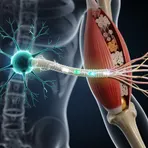
A nerve cell that sends signals from the brain or spinal cord to a muscle to make it move
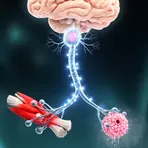
Nerve cell that carries signals from the brain or spinal cord to muscles and glands
Surface Forms
Morphology
Etymology
Motoneuron comes from two parts: motor meaning 'move', as in a car motor, and neuron meaning 'nerve'. So, a motoneuron is a nerve that carries signals from the brain or spinal cord to muscles to make them move.