
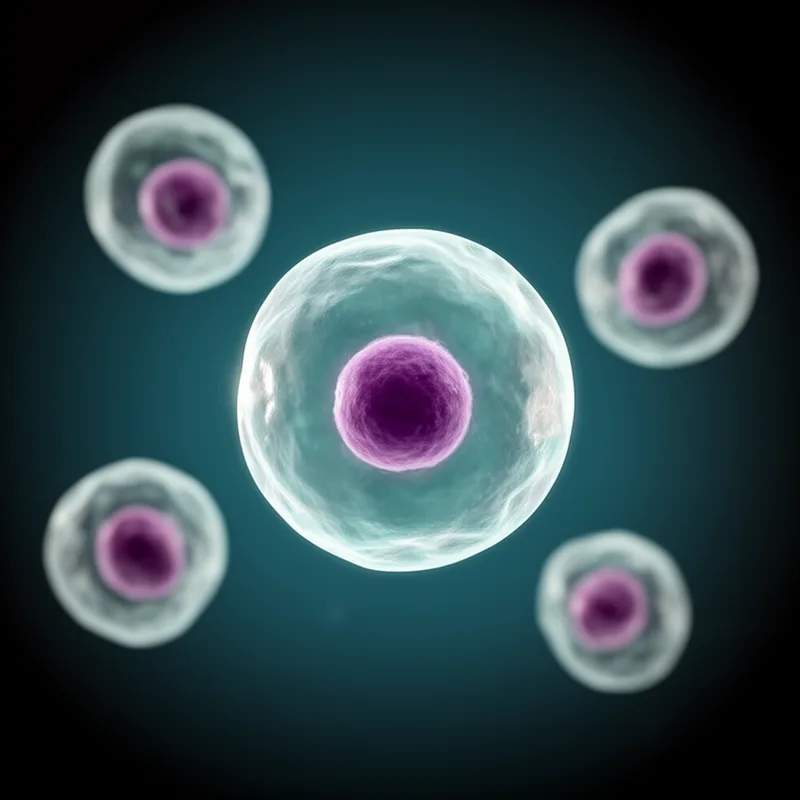
mononucleate
- adjective
- /ˌmɒnoʊˈnjuːkliˌeɪt/
- Specialized
- Unlike muscle fibers, which are multinucleate, these amoebae remain strictly mononucleate.
Examples
-
The scientist identified the sample as mononucleate under the microscope.
-
Most white blood cells in human blood are mononucleate in structure.
-
The mononucleate cells are essential for this process.
-
A mononucleate organism can reproduce more efficiently.
-
Most white blood cells in human blood are mononucleate in structure.
-
The scientist identified the sample as mononucleate under the microscope.
-
Unlike muscle fibers, which are multinucleate, these amoebae remain strictly mononucleate.
Synonyms

A cell or organism that has only one nucleus
A cell that has only one nucleus

Having only one central part inside a cell that holds DNA
Antonyms
Surface Forms
Morphology
mononucleate = nucleate (semi-transparent) = mono + nucle + ate
Adding mono- to nucleate straightforwardly yields the meaning 'having one nucleus.'
Etymology
Mononucleate combines mono- ('one') and nucleus ('center' or 'core'). So it describes a cell that has only one nucleus, and you can see mono- in words like monologue and nucleus in nuclear.

