
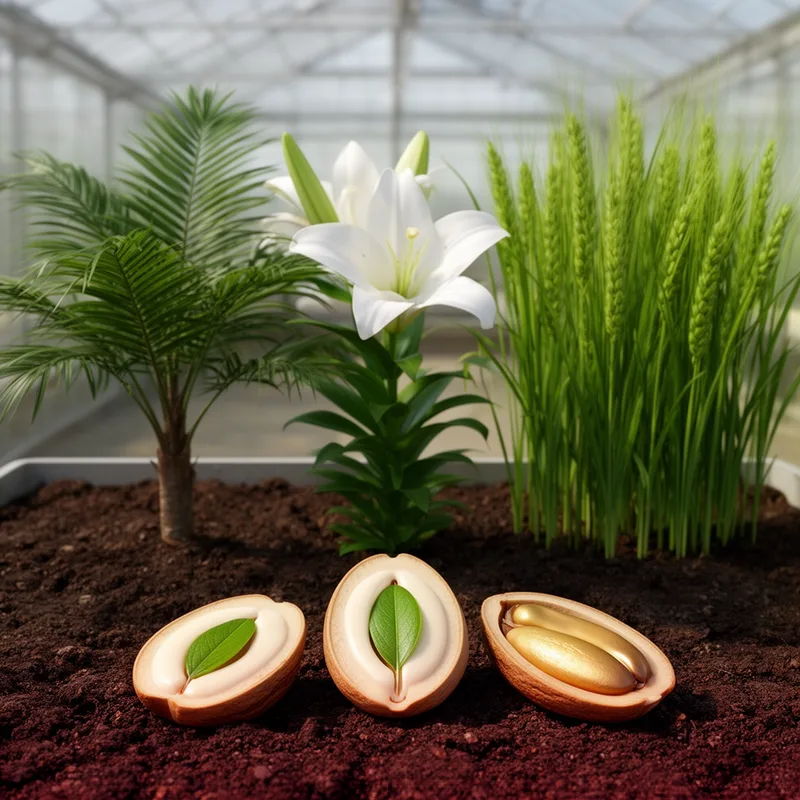
monocot family
- noun
- /ˈmɒnəˌkɒt ˈfæmɪli/
- Specialized
- The monocot family includes grasses and lilies.
Examples
-
The lily belongs to a monocot family distinguished by a single seed leaf.
-
Many plants from the monocot family have parallel leaf venation.
-
Palm trees are a well-known monocot family found in tropical regions.
-
Scientists classified the plant into a new monocot family after genetic analysis.
-
The orchid is a member of the monocot family and is known for its diverse species.
-
Plants in the monocot family typically have flowers with three petals and long, slender leaves.
-
The monocot family includes food crops like rice and corn, essential for many diets.
Synonyms

A group of flowering plants that have one seed leaf, like grasses and lilies
Antonyms

- Specialized
A group of plants that make flowers and whose seeds have two seed leaves, like beans and roses
Surface Forms
Morphology
The meaning is directly compositional: 'monocot' (a plant with one embryonic leaf) combined with 'family' (a taxonomic grouping) yields 'a family of monocot plants'. Although technical, the noun+noun composition follows standard, cross-linguistic patterns, so a B1 learner who knows both constituents can infer the MWE meaning.
Etymology
Monocot family comes from two parts: mono and cotyledon, where mono means 'one' and a cotyledon is the 'seed leaf' a plant starts with. So a monocot family is a group of plants whose seeds have one first leaf, which is why lilies, palms and grasses are in the same family.

