
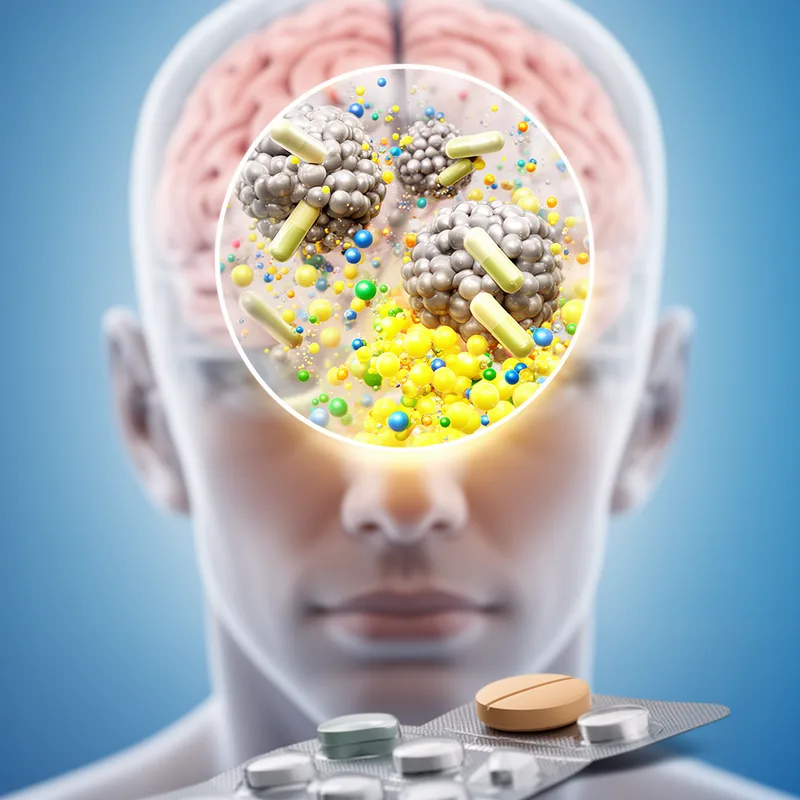
monoamine oxidase inhibitor
 1
6.8
1
6.8

- noun
- /ˌmɒnəʊəˈmiːn ˈɒksɪdeɪz ɪnˈhɪbɪtə/
- Specialized
- For the single drug group using monoamine oxidase inhibitors, the dropout prevalence was 30% (95% CI, 25-36).
- MAO inhibitor
Loading YouTube…
Watch on YouTubeIt does not require activation by a monoamine oxidase inhibitor.
- It does not require activation by a monoamine oxidase inhibitor.
- It's an, it's a light MAOIA monoamine oxidase inhibitor.
- And if you didn't add the reversible monoamine oxidase inhibitor plant derived into this combination, then it would never cross the brain.
Examples
-
Research indicates that monoamine oxidase inhibitors can effectively improve mood in individuals with certain types of depression.
-
And if you didn't add the reversible monoamine oxidase inhibitor plant derived into this combination, then it would never cross the brain.
-
Regarding treatment type, we found that the group treated with SNRIs had the highest prevalence of dropout, followed by those treated with monoamine oxidase inhibitors, TCAs, and SSRIs.
Academic text (2016) -
Monoamine oxidase inhibitors are often prescribed to help alleviate symptoms of depression by enhancing neurotransmitter levels in the brain.
-
Patients taking monoamine oxidase inhibitors should avoid foods high in tyramine to prevent dangerous interactions.
Synonyms
 61
3.4
61
3.4
A medicine that treats depression by changing chemicals in the brain
A medicine for depression that changes chemicals in the brain
Surface Forms
Morphology
monoamine + oxidase + inhibitor
The phrase is fully compositional: 'monoamine oxidase' is the enzyme named by 'monoamine' + 'oxidase', and 'inhibitor' denotes a substance that blocks it, so the meaning 'a substance that inhibits monoamine oxidase' is directly derivable. Although technical, the noun-noun + noun pattern and the 'X inhibitor' construction are standard and cross-linguistically common, so a learner who knows the constituents can predict the meaning.
Etymology
Monoamine oxidase inhibitor is a name that tells the function: monoamine are mood chemicals in the brain, oxidase is the helper that breaks those chemicals down, and an inhibitor 'stops' that helper. So, by 'stopping' the oxidase, the medicine lets mood chemicals 'increase', which is why it is used to treat depression.