

mitochondrion


 1
6.7
1
6.7
- noun
- /ˌmaɪtəˈkɒndriən/
- Specialized
- The mitochondrion is essential for producing energy in almost every cell.
Loading YouTube…
Watch on YouTubeNow glucose stimulates mitochondria to work better.
- Now glucose stimulates mitochondria to work better.
- Sleep disruption impairs mitochondria and mitochondrial function.
- All right, We have a ton of mitochondria in our bodies.
- Well, some patients have diseases of the mitochondria.
- Cold water immersion actually increases your rate of creating new mitochondria.
- They don't have nucleus and they don't have mitochondria.
- Some other eukaryotes like us have another type of organelle called mitochondria.
- We have this going on in all our mitochondria, in all our cells all the time.
- So Astrophage in fact, has mitochondria and ribosomes and everything.
- And that can occur on a small scale outside of mitochondria.
- But that has to happen in the mitochondria.
Examples
-
And so when that happens, the mitochondria make less ATP.
-
We have this going on in all our mitochondria, in all our cells all the time.
-
The single mitochondrion takes many shapes and forms.
Academic text (2001) -
Quick: what's the function of the mitochondrion?
Academic text (2005) -
Keep in mind that the mitochondria look like this.
-
And it turns out that mitochondria have their own DNA.
-
A single mitochondrion (blue) within a human intestinal cell.
Academic text (2001) -
Sleep disruption impairs mitochondria and mitochondrial function.
-
Chloroplasts and mitochondria both contain their own DNA and ribosomes.
-
A mitochondrion (orange) can be seen below the nucleus of a mouse's epithelial cell.
Academic text (2001)
Synonyms
 3
5.6
3
5.6
A small part inside a cell that has one job

A small part inside a cell that makes energy for the cell
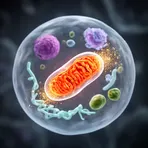
A small part inside a cell that has one job, for example making energy
Surface Forms
Morphology
mitochondrion = mito + chondrion
Although the word is built from Greek combining forms used in scientific vocabulary, those parts are not productive standalone English morphemes and the meaning is not derivable by an average B1 learner from the components.
Etymology
Mitochondrion comes from Greek parts mitos meaning 'thread' and chondrion meaning 'little grain', so the name paints a picture of a 'thread-like little grain'. That's why we call the tiny, often rod- or thread-shaped parts of cells that act like powerhouses and make energy a mitochondrion.