
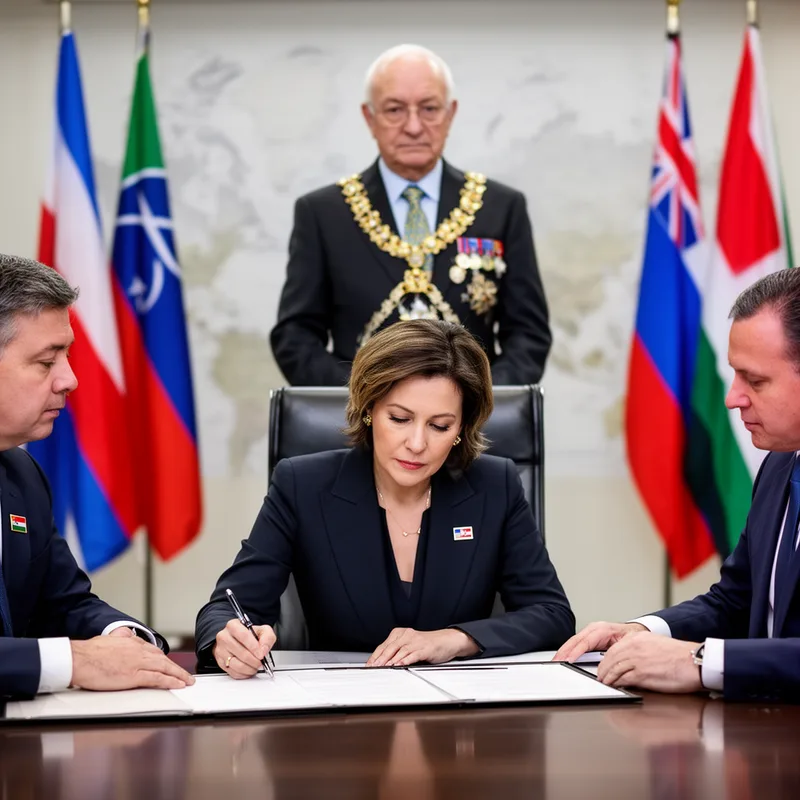
minister plenipotentiary
- noun
- /ˈmɪnɪstər ˌplɛnɪpəˈtɛnʃiˌɛri/
- Formal
- In 1823, the United States appointed minister plenipotentiary John Quincy Adams to negotiate treaties with Russia and Great Britain.
Examples
-
That I yield to the superior force of the United States of America, whose minister plenipotentiary, His Excellency John L. Stevens, has caused United States troops to be landed at Honolulu and declared that he would support the said provisional government.
Academic text (1992) -
The minister plenipotentiary represented his country at the international summit, where he discussed trade relations.
-
As minister plenipotentiary, she had the authority to make significant diplomatic decisions on behalf of the government.
Synonyms

 348
4.2
348
4.2

A diplomat who represents one country to another and ranks below an ambassador
 223
3.6
223
3.6
An official person who represents their country abroad and negotiates with other countries
 94
6.6
94
6.6
A person sent by a government to talk and make agreements with another country
 2
9.9
2
9.9
A diplomat who can make and sign agreements for their country

A government official who represents their country in another country and ranks below an ambassador

A government official sent on a special diplomatic mission with lower rank than an ambassador
Antonyms

How Senior

Surface Forms
Morphology
The meaning is directly compositional: 'minister' denotes a diplomatic official below ambassadorial rank and 'plenipotentiary' denotes one authorized with full negotiating powers, so a learner who knows both words can infer a minister with full authority to represent their government. This noun-noun construction and its logic are found across many languages, making the compound immediately interpretable rather than idiomatic.
Etymology
Minister plenipotentiary comes from the words minister (a country's representative) and plenipotentiary, from old Latin meaning 'full power'. So a minister plenipotentiary is a representative sent with full authority to act and sign agreements for their government, even though they rank below an ambassador.