
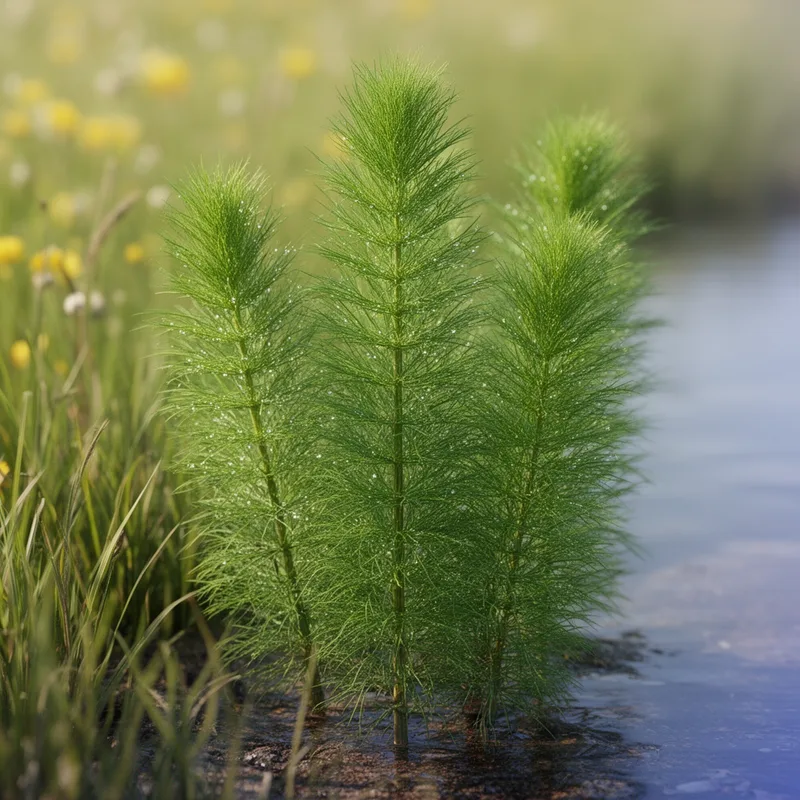
milfoil


 1
9.3
1
9.3
- noun
- /ˈmɪl.fɔɪl/
- Specialized
- As a matter of fact, there was an exotic that invaded the bay in the late '50s, called milfoil, and there were scientists who were dumping herbicides—literally nasty herbicides—to get rid of this plant.
- water milfoil
Examples
-
For example, experiments in which vegetative fragments from both a native pondweed and introduced milfoil species were planted simultaneously show greater biomass productivity in the native species (Table 1; Les et al. 1988).
Academic text (1996) -
Field studies (Les 1990) indicate that plots planted with small fragments of water milfoil can reach carrying capacity in only 16 months (Figure 1).
Academic text (1996) -
No pollution, no milfoil weeds then.
Academic text (2007) -
Milfoil has declined somewhat from its peak abundance in the 1970s but remains a significant element of littoral communities.
Academic text (2007) -
Look at kudzu, Privet hedge, Periwinkle, Milfoil, Asian carp.
Blog text (26) -
Rapid vertical growth under enhanced nutrient regimes enables milfoil to quickly grow to the water surface, where it shades native plants, indirectly causing their decline.
Academic text (1996) -
In the summer, the lake's surface was covered with milfoil, creating a dense habitat for fish.
-
The gardener explained that protecting the milfoil is essential for maintaining the local ecosystem.
-
Boaters often complain about getting tangled in the lush milfoil while navigating through the river.
Compounds
- Specialized
An underwater plant with feathery leaves and small hidden flowers that grows in lakes
Surface Forms
Morphology
milfoil = foil (opaque) = mil + foil
Although historically analyzable as 'mil' + 'foil' ('thousand-leaved'), the components are archaic/combining forms not recognized by most learners, so the compound's meaning is not derivable from its parts.
Etymology
Milfoil comes from the Latin parts mille 'thousand' and folium 'leaf', so it really means a plant with 'a thousand leaves'. That's why milfoil is used for plants like yarrow or water milfoil that have very many fine, feathery leaf parts.