
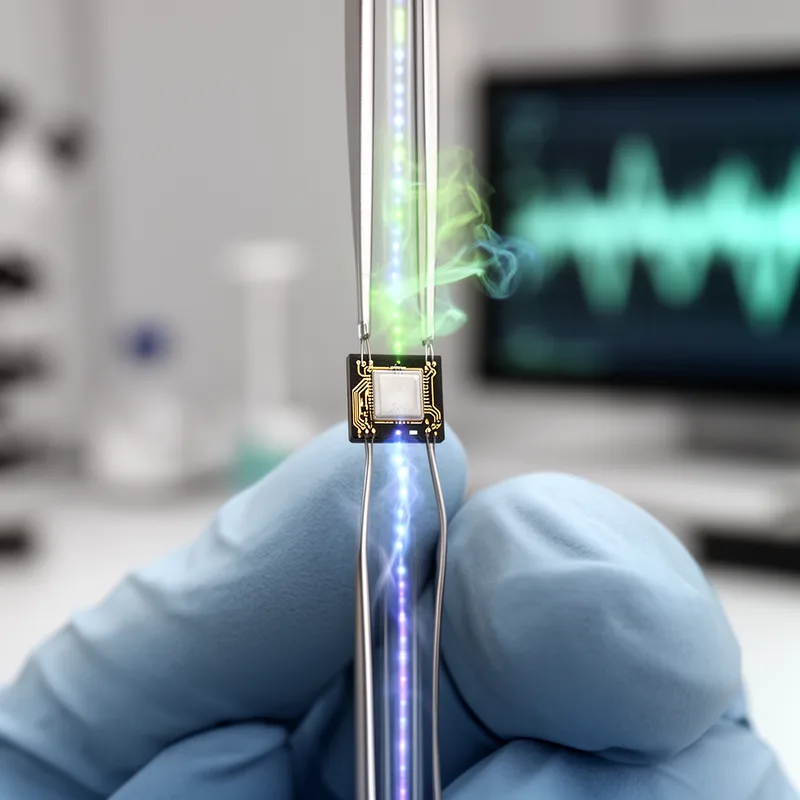
microsensor
- noun
- /ˈmaɪkroʊˌsɛn.sər/
- Specialized
- Microsensors using microstructures and actuators are under development at PNL and elsewhere, including at the University of Michigan in Ann Arbor and at MIT in Cambridge, Mass., and are being commercialized for some applications.
- silicon microsensor
Examples
-
The small size of microsensors allows them to be embedded in a variety of devices, enhancing their functionality.
-
By using microsensors, everyday objects (things) can become "connected and intelligent."
Blog text (31) -
Energy applications are not limited to microsensors.
Academic text (1994) -
Gears, pumps, and valves on the same scale have also been fabricated, as have microsensors that can measure pressure, temperature, mass flow, gas type, and other parameters.
Academic text (1994) -
When particles this size are deposited on the tip of a silicon microsensor, they attract large molecules floating in the air; the attracted chemicals change the oxide's electrical conductance in a way that is easy to detect.
Academic text (2009) -
The present-day state-of-the-art for microsensors—silicon-based MEMS devices—aren't flexible and are hard to integrate into comfortable, wearable materials.
Academic text (2008) -
Researchers are developing microsensors that can measure air quality with exceptional accuracy.
-
Microsensors can detect minute changes in microsensors temperature, making them ideal for precision monitoring.
Synonyms

 898
3.4
898
3.4

A device that notices heat, light, pressure, or movement and sends a signal
A device that detects heat, light, pressure, or movement and produces a signal
How Small

Surface Forms
Morphology
Etymology
Microsensor is made from micro- meaning 'small' and sensor which comes from 'sense' or 'to feel'. So a microsensor is literally a 'small thing that senses', which explains why it means a tiny device that detects changes and makes signals.