

microscopic lens
- noun
- /ˌmaɪkrəˈskɒpɪk lɛnz/
- Specialized
- The scientist adjusted the microscopic lens to get a clearer view of the cell.
Examples
-
Repairing a microscopic lens requires precise handling due to its delicate structure.
-
The microscopic lens allows scientists to see tiny organisms.
-
Dust particles invisible to the naked eye became distinct under the microscopic lens.
-
Did you clean the microscopic lens before using it?
-
The scientist used a microscopic lens to examine the tiny details of the cell structure.
-
A microscopic lens allows us to see microorganisms that are invisible to the naked eye.
-
To study the intricate patterns of the fabric, she placed a microscopic lens over the sample.
Synonyms

 175
2.5
175
2.5

A clear curved piece of glass or plastic that focuses light
 9
5.9
9
5.9
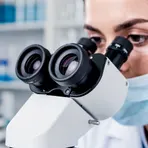
A small lens you look through on a microscope or telescope
 5
7.0
5
7.0
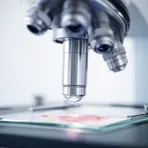
A lens on a microscope or telescope closest to the object


 1
3.9
1
3.9
The lens nearest the object in a microscope or telescope that makes the main image
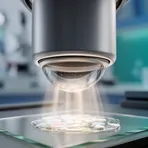
The curved piece of glass in a microscope or telescope nearest the object that makes the first image
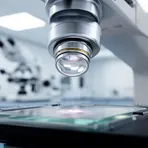
The lens in a microscope or telescope nearest the thing you look at
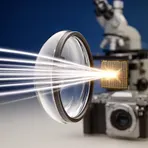
A curved piece of clear glass or plastic that focuses light in cameras and microscopes
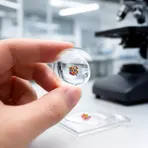
A curved piece of glass or plastic that helps you see things more clearly in instruments
How Strong

Surface Forms
Morphology
The meaning 'a lens used for magnifying extremely small objects' is directly and transparently derived from combining 'microscopic' (extremely small / requiring a microscope) with 'lens' (a device that focuses or directs light). This adjective + noun compositional pattern is straightforward and cross-linguistically common, so a B1 learner who knows both constituents will readily infer the phrase's meaning.
Etymology
The term microscopic lens comes from the simple image of a very small lens that makes tiny things look larger. The word microscopic means 'very small'. So, the phrase means 'a lens used to see very small objects', like the lens in a microscope.