
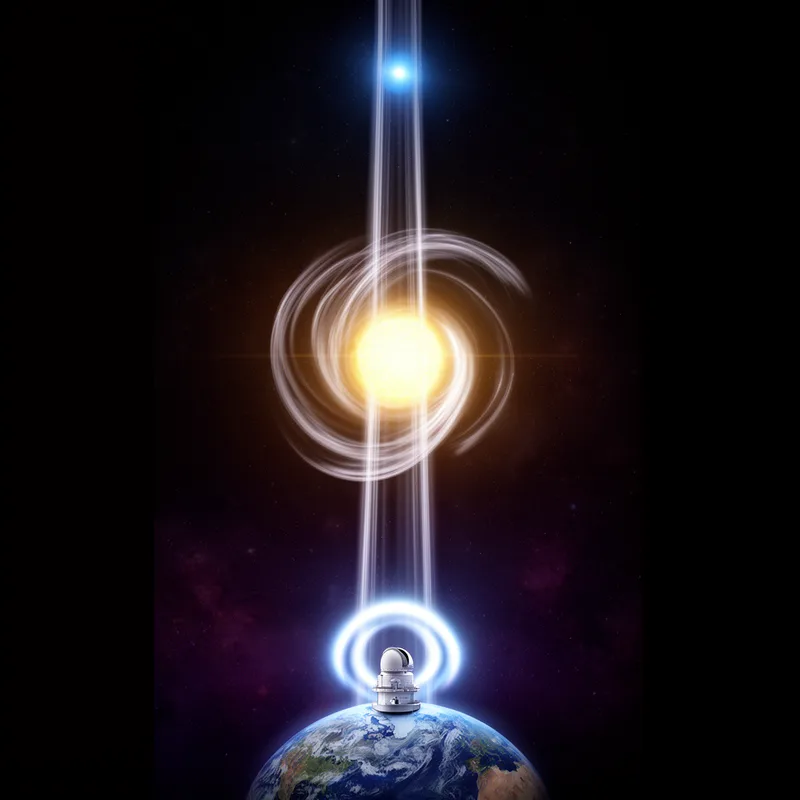
microlensing


 1
9.9
- noun
- /ˈmaɪkroʊˌlɛnsɪŋ/
- Specialized
- The microlensing effect allows researchers to detect planets that would otherwise be invisible due to their distance from Earth.
- gravitational microlensing
- microlensing events
- microlensing technique
Examples
-
Microlensing is a fascinating technique that is already being tested to find planets.
Academic text (2000) -
Microlensing suggests that our galaxy has more planets than stars.
Academic text (2012) -
Like transit observations, microlensing will achieve the higher precision needed to detect Earth-mass planets from space.
Academic text (2000) -
Similarly, black holes are ruled out by (gravitational) microlensing data—there's not enough of them to account for the missing mass.
Blog text (22) -
SIM and TPF are engineering marvels that will not be as cheap as some other planned missions that look for changes in brightness from transiting planets or for microlensing events.
Academic text (2000) -
As the most populous stars in the galaxy, low-mass, M-class dwarfs will be common lensing stars, so microlensing observations may provide important statistical information on the rate of occurrence of planets around these faint stars.
Academic text (2000) -
Astronomers use microlensing to study distant stars by observing how their light is magnified by other cosmic objects.
-
During a microlensing event, the gravity of a foreground object can significantly amplify the light from a background galaxy.
Synonyms
 2
7.6
A lens or gravity bends light and changes how objects look
Surface Forms
Morphology
Etymology
Microlensing combines micro- 'small' and lens 'a piece of glass that bends light'. In space, a small object's gravity acts like that 'lens', bending and magnifying light from a distant star, which is why microlensing helps astronomers find hidden planets.