
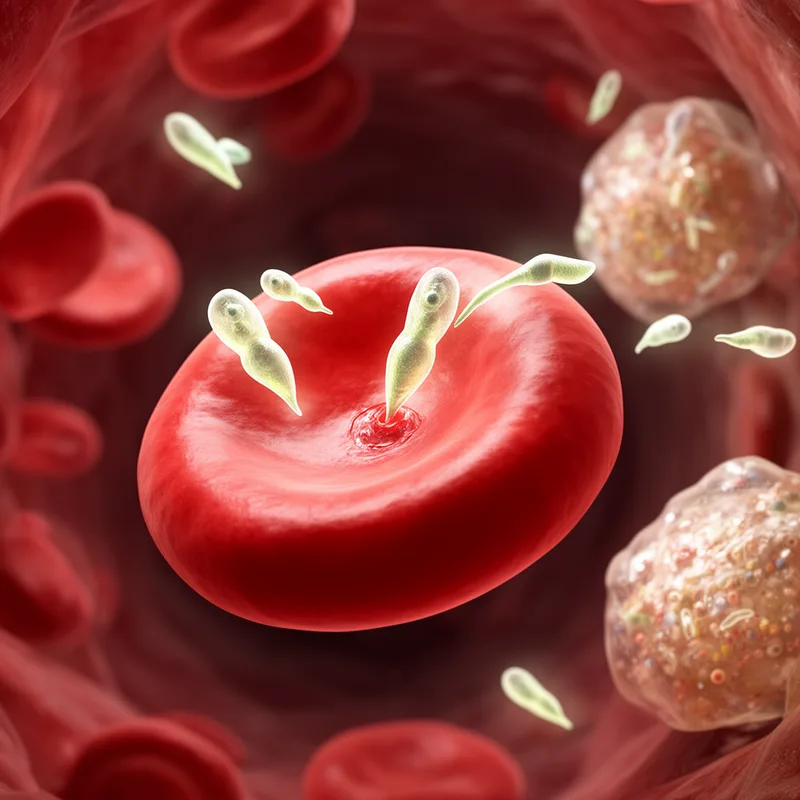
merozoite


 1
9.9
- noun
- /ˈmɛrəˌzoʊɪt/
- Specialized
- Once released into the bloodstream, merozoites can rapidly multiply within red blood cells.
Examples
-
The merozoites invade new host cells, leading to the spread of malaria.
-
Recrudescent and new infections were distinguished by comparison of polymorphisms in merozoite surface protein 2 (MSP2).
Academic text (2002) -
In the lifecycle of the malaria-causing parasite, merozoites are crucial for infecting red blood cells.
Surface Forms
Morphology
merozoite = mero + zoite
Although specialists may recognize the classical elements, an average learner cannot reliably infer the specific parasitological sense of a cell stage in the malaria life cycle from the parts alone.
Etymology
Merozoite comes from the Greek parts meros ('part') and zoon ('animal'), and the zoon part is the same idea as in 'zoo' and 'zoology'. So a merozoite is like a 'part-animal' stage of a parasite, a small form that moves into new cells, which explains why merozoites invade and multiply in the body.