
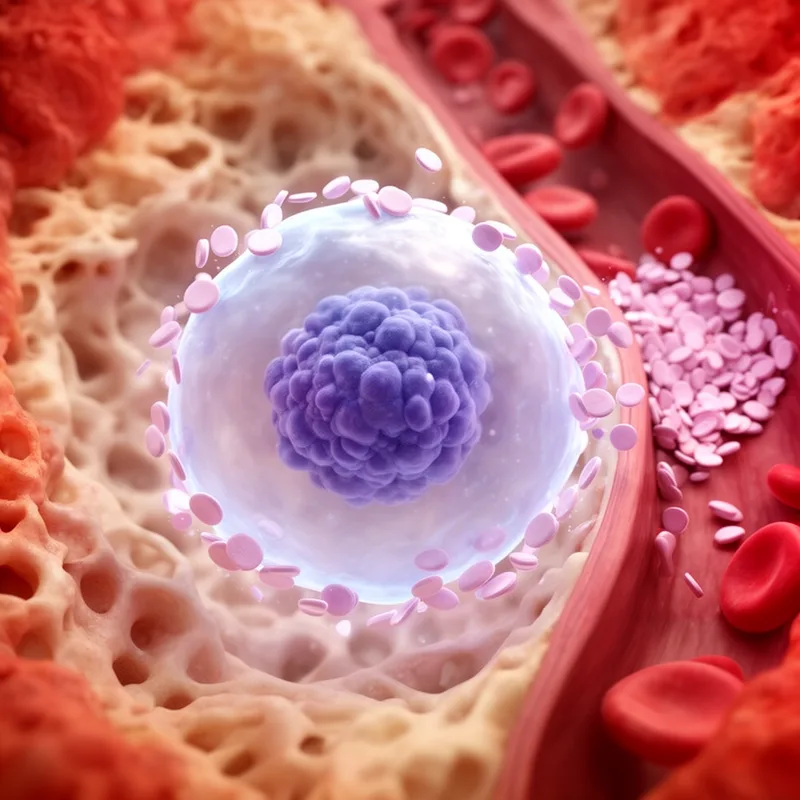
megakaryocyte


 1
9.9
- noun
- /ˌmɛɡəˈkɛəriəˌsaɪt/
- Specialized
- Changes in the platelet, an anucleate cell, are determined by alterations in the behavior of its progenitor cell, the bone-marrow megakaryocyte.
- megakaryocyte fragmentation into platelets
- marrow megakaryocyte
- bone marrow megakaryocytes
Examples
-
The increase in platelet size seen in our study indicates that megakaryocyte changes take place before the second MI.
Academic text (1991) -
Megakaryocytes are different both after an MI and at the time of sudden cardiac death.
Academic text (1991) -
Control of platelet production from megakaryocytes may have future therapeutic potential in MI.
Academic text (1991) -
Since platelets have no nuclei, most of their contents are determined by the genetic message in their precursor cell, the bone-marrow megakaryocyte.
Academic text (1991) -
Furthermore, there is evidence that mean platelet volume (MPV) is determined at or before the time of megakaryocyte fragmentation into platelets.
Academic text (1991) -
The megakaryocyte produces platelets, which are essential for blood clotting.
-
Research shows that each megakaryocyte can generate thousands of platelets.
-
In the bone marrow, the megakaryocyte is responsible for maintaining platelet levels.
Surface Forms
Morphology
megakaryocyte = karyocyte (opaque) = mega + karyo + cyte
The word is built from classical combining forms, but the specialized biological meaning is not recoverable for an average B1 learner from the parts alone.
Etymology
Megakaryocyte breaks into mega- 'large', karyo- 'nucleus', and -cyte 'cell'. So a megakaryocyte is a very large cell with a big nucleus in the bone marrow that makes platelets.