

mechanical stress
- noun
- /məˈkænɪkəl strɛs/
- Specialized
- Kosiak (1, 19) studied the response of skin to mechanical stress and proposed a pressure-duration relationship for skin breakdown.
- mechanical stress on skin
- cause increased mechanical stress
- response to mechanical stress
Examples
-
Relief of the mechanical stress on the facet is signaled by symptomatic reduction.
Academic text (1997) -
The knowledge gained concerning skin response to mechanical stress from clinical experience and from basic science studies to date emphasizes an important concept.
Academic text (1995) -
Yes, The less the impact across your joints, the less mechanical stress you provide.
-
The purpose of this paper is to review that literature, particularly information addressing skin adaptation to mechanical stress.
Academic text (1995) -
Both breakdown and adaptation of skin to mechanical stress are addressed below.
Academic text (1995) -
The injection route, however, places a great deal of mechanical stress on the hairs, and they disappear immediately.
Academic text (2004) -
Mechanical stress and trauma may be important in the pathogenesis of PXE.
Academic text (2007) -
Several investigators have sought to assess the effects of mechanical stress on skin and tissue using animal models (19, 20, 23-29).
Academic text (2001) -
Mechanical stress and stress gradients increase pressure gradients in interstitial fluid around an area of bone injury.
Academic text (2003) -
The slight deformations in the soft rubber revealed a 3D map of the mechanical stress that causes paint to peel.
Synonyms
 105
6.9
105
6.9

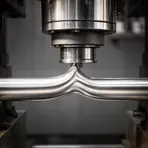
Force on a material that makes it change shape
How Stressed
- Specialized

- Specialized
Surface Forms
Morphology
The noun phrase is transparently compositional: 'mechanical' specifies the domain/type of 'stress', so a learner who knows 'mechanical' (relating to mechanics/machines) and 'stress' (force per unit area) can infer it denotes forces within a material or machine. The technical qualifiers (elastic/viscous) add detail but do not block the basic, predictable meaning, which is a common construction across languages.
Etymology
Mechanical stress paints a simple picture: mechanical points to machines or moving parts, and stress is the inside 'push' or 'pull' when you bend, squeeze, or pull an object. Imagine bending a paperclip — the metal inside feels those pushes and pulls and may bend or 'break', so the term means the inside forces that can make something break.