
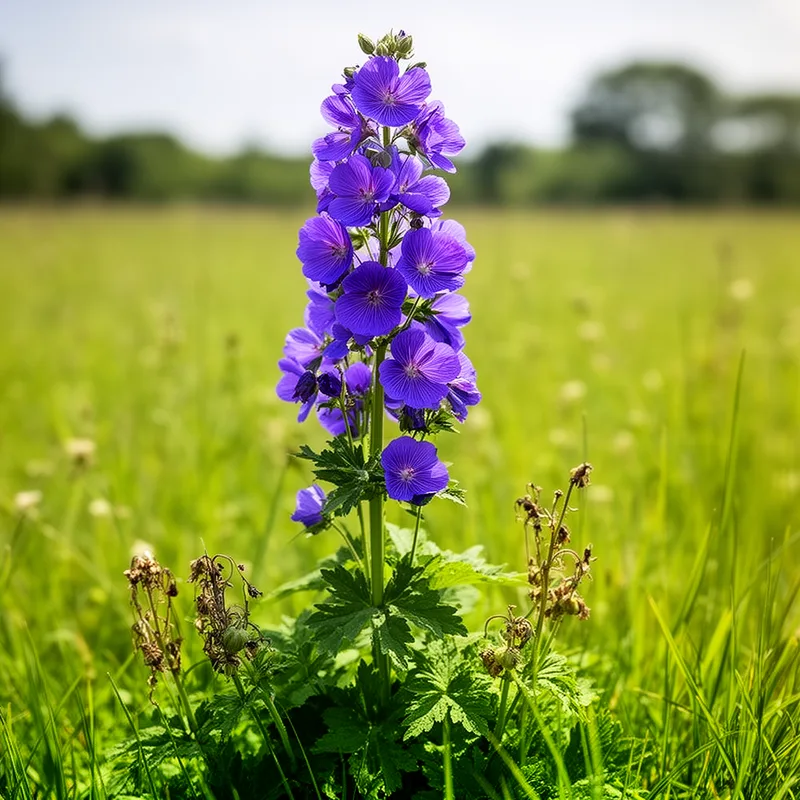
meadow cranesbill
- noun
- /ˈmɛdoʊ ˈkreɪnzˌbɪl/
- UK
- Gardeners often plant meadow cranesbill for its resilience and attractive foliage.
Examples
-
The meadow cranesbill brightened the field with its vivid violet flowers each summer.
-
We spotted several meadow cranesbills along the riverbank during our hike.
-
The meadow cranesbill blooms beautifully in the summer.
-
Many gardeners love the meadow cranesbill for its vibrant flowers.
-
The meadow cranesbill adds beautiful violet-blue flowers to the garden.
-
In spring, the meadow cranesbill blooms, filling the fields with vibrant colors.
-
Wildlife loves the meadow cranesbill, as its flowers attract various pollinators.
Synonyms

A tall plant that lives for many years and has bright blue flowers that grow in meadows

A plant that lives for more than one year and has hand-shaped leaves and showy five-petaled flowers
Surface Forms
Morphology
The noun phrase is compositionally transparent: 'meadow' specifies the habitat or type of the head noun 'cranesbill', so a learner who knows both words can infer it is a kind of cranesbill found in meadows. This noun–modifier pattern is a common, cross-linguistic way to form plant names and is therefore immediately predictable to a B1 learner.
Etymology
Meadow cranesbill comes from the plant's shape: its long seed pod looks like a crane's 'beak', so people called it cranesbill. Because the plant often grows in open fields, the word meadow was added, so the name points to a field plant with a beak-like seed pod.

