

maxillary artery


 1
5.5
1
5.5
- noun
- /ˈmæksɪˌlɛri ˈɑrteri/
- Specialized
- An injury to the maxillary artery can lead to significant swelling in the face.
- internal maxillary artery
- distal maxillary artery
- maxillary artery embolization
Examples
-
Figure 2: Angiogram of the internal maxillary artery
Academic text (2003) -
Post-embolization angiography showed complete occlusion of the left internal maxillary artery and its distal branches.
Academic text (1995) -
Patient 2: A: Left internal maxillary artery, pre-embolization; B: Post-embolization, showing complete occlusion.
Academic text (1995) -
The left distal internal maxillary artery was then embolized with Gelfoam pledgets.
Academic text (2002) -
Two cases of intractable epistaxis, which were definitively treated with internal maxillary artery embolization, are presented with an algorithm for the management of similar cases.
Academic text (1995) -
Only one of our three patients (patient 3) experienced any significant vascular injury: a distal internal maxillary artery laceration that was detected and treated.
Academic text (2002) -
Two patients with intractable epistaxis who were definitively treated with internal maxillary artery embolization are presented, and the efficacy of this treatment is discussed.
Academic text (1995) -
Postembolization angiography revealed complete occlusion of both the left distal internal maxillary artery and the left facial artery (Figure 3, C).
Academic text (2002) -
The maxillary artery supplies blood to the jaw and cheeks.
-
During the surgery, the doctor carefully avoided damaging the maxillary artery.
Synonyms
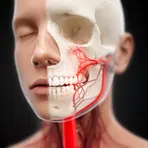
A blood vessel that supplies the upper jaw, teeth, and face

A blood vessel that carries blood to deep parts of the face and to the covering of the brain
Surface Forms
Morphology
The noun is a straightforward compositional combination of the adjective 'maxillary' (pertaining to the upper jaw) and 'artery' (a blood vessel), so its meaning — an artery supplying the maxilla/upper jaw area — is directly derivable from the parts. Although medical, the semantic composition follows regular English noun+modifier patterns and is cross-linguistically transparent, so a learner who knows both constituents will understand the term.
Etymology
Maxillary artery is named because maxillary means 'upper jaw' and artery means a 'blood vessel'. The artery goes to the upper jaw and face, so the name means 'the blood vessel that gives blood to the upper jaw'.