

matrilocal


 1
9.1
- adjective
- /ˌmætrɪˈloʊkəl/
- Specialized
- "Women are also more knowledgeable about the land, since traditionally Navajo are matrilocal, meaning married couples live with the wife's clan, and it is the wife who is most familiar with the history and sacred areas of their land," she wrote.
- matrilocal residence
- matrilocal residence patterns
Examples
-
They show that even in patriarchal societies, matrilocal residence was an important phenomenon.
Academic text (1992) -
The Kuna of Kuna-Yala live in 49 communities, with matrilocal residence and bilateral inheritance.
Academic text (2006) -
Generally, the population had divided into matrilocal bands.
Academic text (1990) -
New house sites continue to reflect a matrilocal, resource-conserving tradition.
Academic text (1990) -
The traditional landscape reflected a matrilocal, closely spaced pattern.
Academic text (1990) -
The influence of Mennonite women was especially evident in matrilocal residence patterns and in shaping the nature of secondary migrations.
Academic text (1992) -
Where matrilineal and matrilocal organization dominate, women may have more authority (Nash 1978).
Academic text (1990) -
Two research projects between 1958 and 1963 documented the preference for matrilocal settlement (Kunstadter 1963; Boyer 1964).
Academic text (1990) -
During the early 1900s, the Mescalero and Lipan groups continued to live in matrilocal settlements along Tularosa, Nogal, Three Rivers, and Elk-Silver creeks.
Academic text (1990) -
In many cultures, newlyweds choose to live in a matrilocal arrangement, staying close to the wife's family for support.
Synonyms
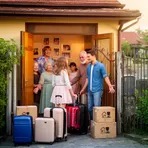
A custom where a married couple lives with or near the wife's family
Antonyms

- Specialized
1
8.9
A custom where a married couple lives with or near the husband's family
How Matrilocal
- Specialized
1
9.1

- Specialized
1
8.9
Surface Forms
Morphology
Etymology
The word matrilocal comes from matri- ('mother') and local ('place' or 'nearby'). So matrilocal describes a custom where a married couple lives with or near the wife's family — in other words, 'in the mother's place', which explains the modern meaning.