
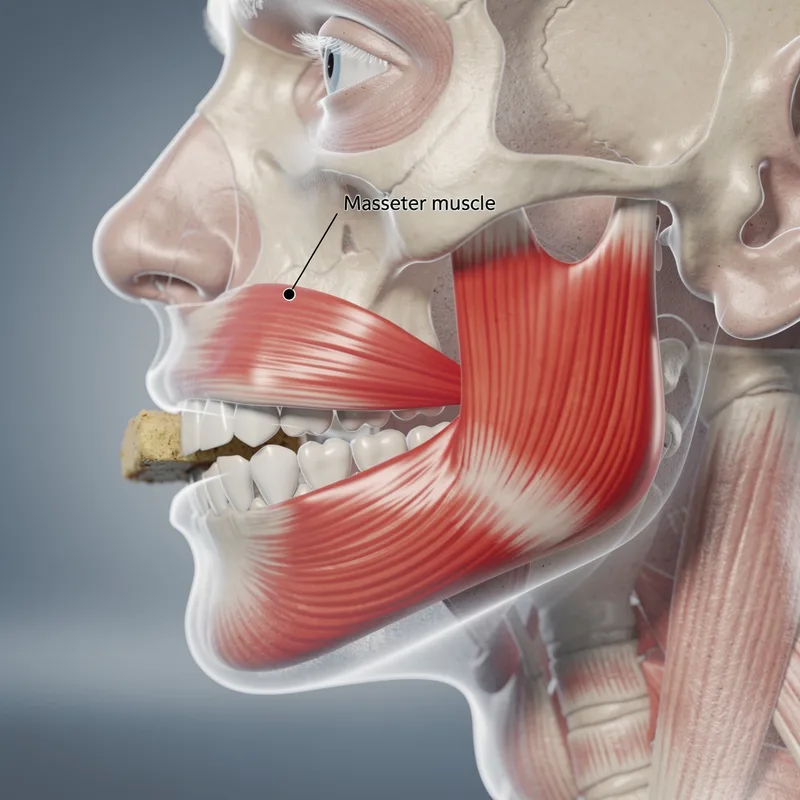
masseter
 1
9.3

- noun
- /ˈmæsɪtər/
- Specialized
- The masseter muscle is essential for chewing food properly.
- masseter muscle
Examples
-
She felt pain in her masseter after grinding her teeth at night.
-
There were also significant differences between the first and second music conditions for both masseter and frontalis muscles.
Academic text (2008) -
The primary advancement occurred in the masseter muscle.
Academic text (2003) -
One sensor was placed on the belly of each masseter, and the negative or ground sensor was placed directly on the mandible.
Academic text (2008) -
It has bifurcated masseter muscles.
-
In the head and neck region, the masseter muscle and parotid gland are commonly involved deep structures.
Academic text (1998) -
Approximately 1% of hemangiomas localize in the muscles of the head and neck, most commonly the masseter and trapezius muscles.
Academic text (2008) -
The masseter, pterygoid, and temporalis muscles, as well as the eyelids and parotid glands, were also affected.
Academic text (2004) -
The muscle fibers that constituted the deep masseter, which grew off anteriorly to relieve the stress on the jaw joint, were ideally suited for mastication and better jaw control.
Academic text (2003) -
The doctor explained that the masseter is one of the strongest muscles in the jaw.
Surface Forms
Etymology
Masseter comes from the Greek massetēr, from massein meaning 'to chew', and you can see the same root in the English word masticate ('to chew'). So the masseter is the large jaw muscle that lifts the lower jaw and helps you chew, which is why it has that name.