

masked ball
 2
4.3
2
4.3

- noun
- /mæskd bɔl/
- Formal
- The invitation to the masked ball included a statement to dress in formal attire.
Examples
-
For on November 26, 1966, he threw a masked ball for Katherine Graham at New York's Plaza Hotel.
Blog text (28) -
It's an invitation to a masked ball.
-
We should all go to Paris for the masked ball.
-
Can we have a masked ball?
-
We are to perform at a great masked ball.
Fiction book (1996) -
Queen Catherine: Has everyone decided what to wear to the masked ball?
Fiction book (2000) -
It is a masked ball.
-
You were going to show me the sketches you made for my dress for the masked ball.
Fiction book (1993) -
Mr. Kaufman cordially invites residents of the Green to a masked ball on the eve of Allhallows.
-
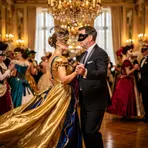
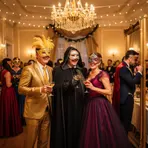
Everyone is excited to attend the masked ball where guests will wear glamorous costumes and intricate masks.
Synonyms
 41
6.4
41
6.4
A party where people wear costumes and face coverings, often with dancing
 14
6.8
14
6.8
A party where people wear masks and fancy costumes
 4
4.8
4
4.8
A formal party where guests wear masks and costumes to hide who they are
 1
4.3
1
4.3
A party where people wear masks and costumes to hide who they are
 1
7.0
1
7.0
A formal party where people wear costumes and masks and dance
How Formal

Surface Forms
Morphology
The meaning is directly compositional: 'masked' (wearing or having a mask) modifies 'ball' (a formal dance), so a learner who knows both words can infer it is a dance where guests wear masks. This adjective+noun pattern is common cross-linguistically and follows normal English composition, making the phrase immediately predictable for a B1 learner.
Etymology
Masked ball comes from old European parties where people wore masks and danced at a ball. Wearing a mask let guests 'hide who they were' so they could meet and behave freely, so the phrase now means a formal dance where guests wear masks.