
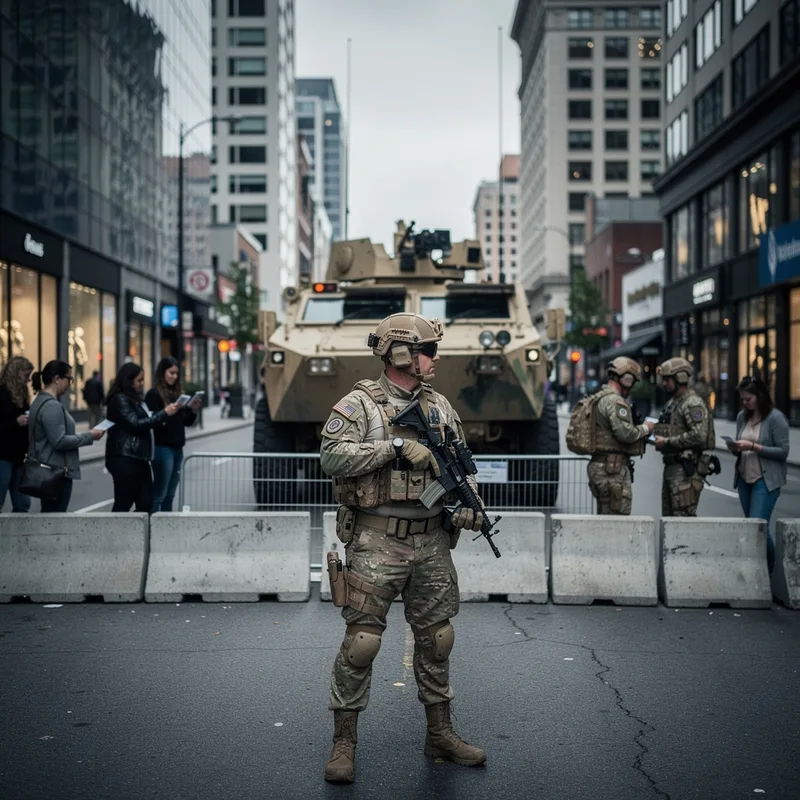
martial law
 37
7.7
37
7.7

- noun
- /ˈmɑrʃəl lɔ/
- Formal
- After the military coup, the country was placed under martial law until elections could be held.
- declare martial law
- impose martial law
- imposition of martial law
Loading YouTube…
Watch on YouTubeAnd it they're just, it was almost like martial law was in effect.
- And it they're just, it was almost like martial law was in effect.
- He banned public gatherings, arrested politicians, imposed martial law and also banned the Free Press.
- But he talks about like that it's he worries about martial law.
- We can't deny also so the reality that we're going to be accepting a form of martial law to a certain degree.
Examples
-
In 1987, this changed: martial law was terminated and establishing new political parties was legalized.
Academic text (1993) -
In the U.S., the authorities declared martial law.
-
The state of martial law has been issued.
-
This area is under martial law.
-
For now, martial law is in effect.
-
Emergency legislation and martial law created a wide scope for the abuse of authority.
Academic text (1990) -
On 20 May, immediately after the guests' departure, however, the Chinese government imposed martial law.
Academic text (1990) -
President Lincoln declared martial law in 1862.
-
Beginning tonight and continuing until the crisis passes, I am declaring a state of martial law.
-
The imposition of martial law has turned a student movement into a nationwide movement.
Academic text (1990)
Synonyms
 7
5.6
7
5.6
The army rules a country after it takes power
How Military
- Formal
37
7.7

- Literature
18
8.1
- Formal
7
5.6
1
5.9
574
2.6
Surface Forms
Morphology
The meaning 'rule by military authorities' is directly and predictably derived from combining 'martial' (military) with 'law' (rules or regulations); the constituents transparently indicate law imposed by the military. This compositional pattern is cross-linguistically common (e.g., Spanish 'ley marcial', French 'loi martiale') and follows standard adjective+noun semantics, so a B1 learner who knows both words would understand it.
Etymology
Martial law comes from times when soldiers take control of a town; martial means 'of soldiers or war' and law means the rules people must follow. That's why the phrase now means 'temporary rule by the military' when normal civil law is put aside.